
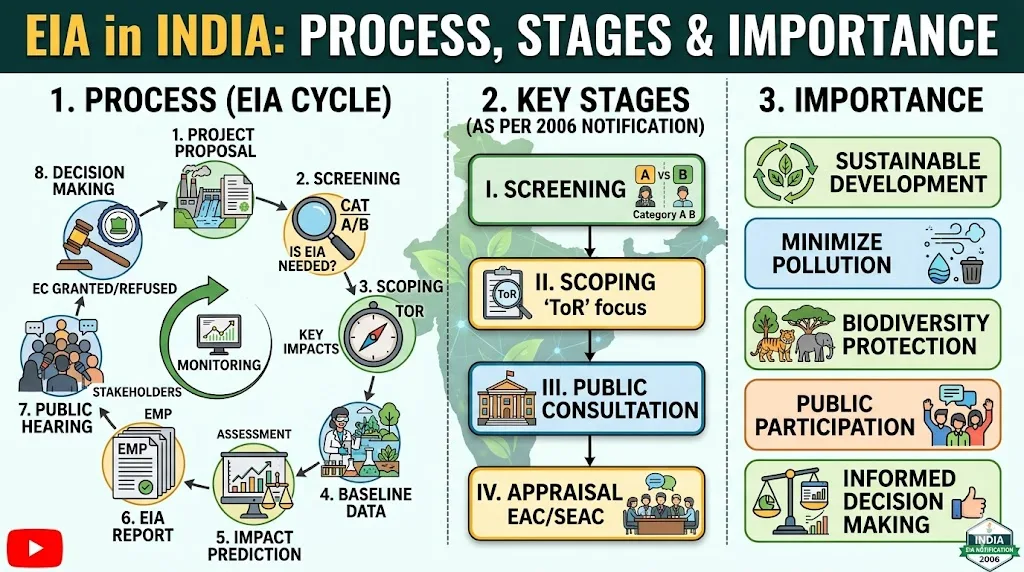
Environmental Impact Assessment, commonly known as EIA, is one of the most important tools used to protect the environment from the harmful effects of large development projects. Before a major project such as a power plant, mine, highway, or factory is allowed to begin, the government uses EIA to study how that project will affect the surrounding environment, people, and wildlife — and whether those effects can be reduced or managed.
For students preparing for UPSC, SSC, state PSC, and other competitive exams, EIA is a high-value topic in the environment and ecology section. This guide explains what EIA is, how it developed in India, the four main stages of the process, the categories of projects, and the key facts examiners frequently test.
What Is Environmental Impact Assessment (EIA)?
EIA is a process used to evaluate the likely environmental effects of a proposed project before it begins. The goal is to identify potential damage to the environment, human health, and biodiversity in advance, so that harmful impacts can be avoided, reduced, or managed through proper planning.
In simple terms, EIA asks a vital question before a project starts: “What will this project do to the environment, and how can we limit the harm?” By considering environmental factors early in the planning stage, EIA helps achieve sustainable development — balancing economic growth with environmental protection.
History of EIA in India
The need for environmental regulation in India grew sharply after the Bhopal Gas Tragedy of 1984, one of the world’s worst industrial disasters. This event exposed the dangers of inadequate environmental oversight and led directly to the enactment of the Environment (Protection) Act, 1986 — the main legal foundation for environmental regulation in India.
The first official EIA Notification was introduced in 1994, making environmental clearance mandatory for certain categories of projects. This framework was significantly strengthened by the revised EIA Notification of 14 September 2006, which remains the governing law today. The 2006 notification introduced clear project categorisation, formalised public consultation, and standardised the appraisal procedure.
Legal Framework
The EIA process in India rests on two pillars:
- The Environment (Protection) Act, 1986 — the parent legislation.
- The EIA Notification, 2006 — which lays down the actual procedure for obtaining Environmental Clearance (EC).
Categories of Projects Under the EIA Notification 2006
A key feature of the 2006 notification is that it decentralised the clearance process by dividing projects into two categories based on their size and potential environmental impact:
- Category A projects are large-scale activities with significant environmental effects (for example, nuclear power projects, major ports, airports, and primary metallurgical industries). These require clearance from the central government — the Ministry of Environment, Forest and Climate Change (MoEFCC) — based on the recommendation of an Expert Appraisal Committee (EAC). Category A projects always require a full EIA.
- Category B projects are smaller in scale and are cleared at the state level by the State Environment Impact Assessment Authority (SEIAA), based on the advice of the State Expert Appraisal Committee (SEAC). Category B projects are further divided into B1 (which require a full EIA report) and B2 (which do not).
The Four Stages of the EIA Process
Under the 2006 notification, the EIA cycle consists of four main stages. Not every stage applies to every project — it depends on the category and scale.
1. Screening
Screening is the first filter and applies specifically to Category B projects. The State Expert Appraisal Committee (SEAC) reviews the application (submitted in Form 1) and decides, based on the nature and location of the project, whether a detailed EIA study is required. Projects that need an EIA are classified as B1, while those that don’t are classified as B2. Category A projects skip screening because they automatically require a full EIA.
2. Scoping
In the scoping stage, the appraisal committee (EAC or SEAC) prepares the Terms of Reference (ToR) — a document that specifies exactly what studies, data, and analyses the EIA report must include. The ToR is based on the nature of the project, on-site inspections, and the surrounding environment. Scoping ensures the EIA focuses on the most important environmental concerns.
3. Public Consultation
This is one of the most important and democratic stages. It typically has two components:
- A public hearing held at or near the project site, coordinated by the State Pollution Control Board, with at least 30 days’ notice.
- The collection of written responses from affected people and stakeholders.
A draft EIA report must be made available in English and the regional language so local communities can understand it. All feedback gathered must be addressed in the final EIA report. This stage gives local communities a voice before a project affecting them is approved.
4. Appraisal
In the final stage, the EAC (for Category A) or SEAC (for Category B) carefully reviews the complete EIA report, the Environmental Management Plan (EMP), and the outcomes of the public consultation. The committee then recommends to the regulatory authority — the MoEFCC for Category A or the SEIAA for Category B — whether Environmental Clearance (EC) should be granted or refused. If granted, the project may proceed, subject to conditions.
Benefits of EIA
A properly conducted EIA offers several important benefits:
- Protects the environment by identifying and reducing harm before a project starts.
- Promotes optimum use of resources, saving time and cost in the long run.
- Reduces conflicts by involving local communities through public consultation.
- Informs decision-makers with scientific data rather than guesswork.
- Supports sustainable development by balancing economic and environmental needs.
Criticisms and Challenges of EIA in India
Despite its importance, the EIA process in India faces several well-documented problems that examiners often ask about:
- Poor quality of reports: There have been cases of fraudulent EIA studies using erroneous or copied data — sometimes the same facts used for two entirely different sites.
- Limited expertise: EIA teams often lack specialists such as ecologists, wildlife experts, and social scientists.
- Weak public participation: Many significant projects have been excluded from mandatory public hearings, and required documents are often not made available on time.
- No post-clearance monitoring: The notification largely limits itself to the point at which clearance is granted, with weak enforcement afterward.
- Exemptions: Several projects with significant impacts are exempted because they fall below the investment thresholds or are not listed in the schedule.
The controversial Draft EIA Notification 2020 reignited debate around transparency, reduced public consultation periods, and the issue of post-facto (after-the-fact) clearances, drawing strong criticism from environmental groups.
Key Facts to Remember for Exams
- EIA in India is governed by the Environment (Protection) Act, 1986 and the EIA Notification, 2006.
- The first EIA Notification came in 1994; the comprehensive version came in 2006.
- Projects are divided into Category A (central/MoEFCC) and Category B (state/SEIAA).
- Category B is split into B1 (needs EIA) and B2 (does not).
- The four stages are Screening, Scoping, Public Consultation, and Appraisal.
- The final outcome is the grant or refusal of Environmental Clearance (EC).
- Applications are now processed through the PARIVESH portal.
Conclusion
Environmental Impact Assessment is a crucial safeguard that ensures development in India does not come at an unacceptable cost to the environment and to local communities. By systematically studying a project’s likely effects through screening, scoping, public consultation, and appraisal, EIA helps decision-makers approve only those projects whose environmental impacts can be properly managed.
While the system has real weaknesses — from report quality to weak monitoring — it remains one of India’s most important environmental governance tools. For competitive exam aspirants, understanding the EIA Notification 2006, the four stages, the project categories, and the major criticisms will help you confidently answer questions in the environment and ecology section.
Note: Environmental rules and notifications are periodically amended. Always refer to the official MoEFCC website and the PARIVESH portal for the latest provisions.

Zahid Bhat is an education writer with over 6 years of experience covering government jobs, competitive exams, and scholarships across India. He writes for REFE JOB to help students and aspirants — from Jammu & Kashmir to Tamil Nadu — get accurate, free, and timely information about SSC, IBPS, UPSC, JKSSB, and state recruitment boards. Every post is sourced from official notifications and government portals.