
Picture this: A legislator wins an election on a party ticket. Thousands of voters cast their ballot for that person because of the party they represent, the ideology they carry, and the promises they made. Then, weeks later, that same legislator quietly walks across the aisle and joins the opposition — often in exchange for a ministerial post, a cabinet berth, or simply a better deal. The voters who elected them get nothing. Their mandate is quietly discarded.
This is political defection. And for decades in post-Independence India, it was a sport played openly and without consequences.
India’s Anti-Defection Law was Parliament’s attempt to end that sport. Introduced in 1985 and embedded in the Tenth Schedule of the Constitution, it is one of the most discussed, most litigated, and most debated provisions in Indian constitutional law. Four decades later, the law has delivered some stability — but it has also created its own set of problems, loopholes, and controversies that continue to reshape Indian politics every election season.
This article explains everything about the Anti-Defection Law: what it says, why it was needed, how it works in practice, what the courts have ruled, and why the debate around reforming it is louder than ever in 2025 and 2026.
The Problem That Created the Law
To understand why the Anti-Defection Law exists, you have to understand what Indian politics looked like before it.
In the 1960s and 1970s, India witnessed what political commentators began calling the “Aaya Ram Gaya Ram” era — named after a Haryana MLA, Gaya Lal, who famously switched parties three times in a single day in 1967. That phrase became a biting summary of an era when legislators treated party loyalty as a minor inconvenience and floor-crossing as a career strategy.
Between 1967 and 1971, more than 3,000 cases of defection were recorded in state assemblies across India. Governments fell, coalitions collapsed, and elected mandates were routinely betrayed — not for ideological reasons, but for personal gain.
The Chavan Committee (1967) was one of the earliest bodies to study the defection problem and recommend a legal solution. It took nearly two decades, but in 1985, Parliament finally acted.
What Is the Anti-Defection Law? — The Tenth Schedule Explained
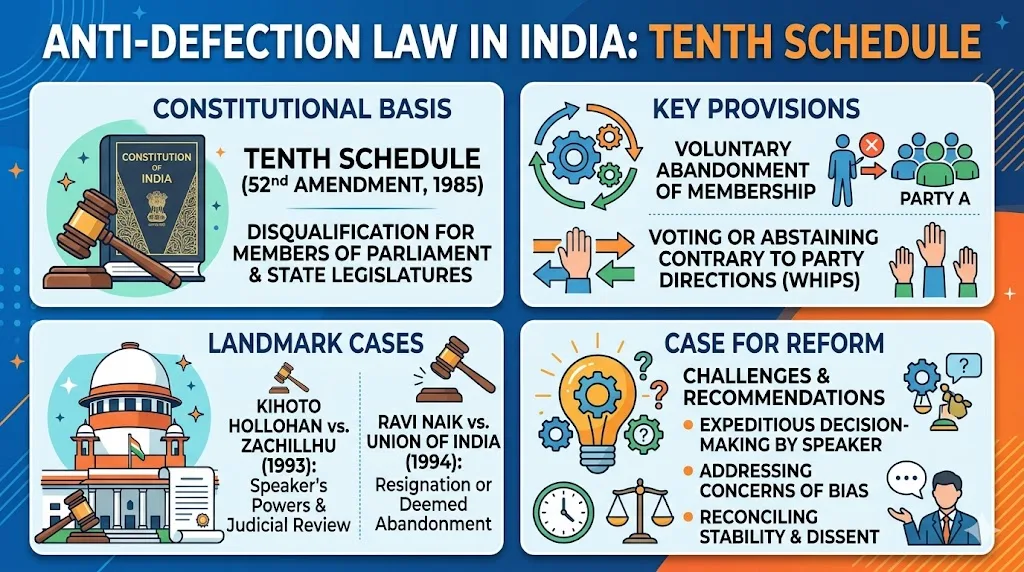
The Anti-Defection Law was introduced through the 52nd Constitutional Amendment Act, 1985, which added the Tenth Schedule to the Indian Constitution. The law applies to both Members of Parliament (MPs) and Members of State Legislative Assemblies (MLAs).
In plain language, the law says this: if you were elected on a party’s ticket, you must remain loyal to that party. Betraying it — in specific defined ways — means you lose your seat.
Grounds for Disqualification
Under the Tenth Schedule, a member of a legislature becomes disqualified if:
1. Voluntary Resignation from the Party If a member voluntarily gives up the membership of the political party on whose ticket they were elected, they face disqualification. The key word is “voluntarily” — courts have clarified that mere anti-party statements are not sufficient; a formal act of giving up membership is required.
2. Voting Against the Party Whip If a member votes in the legislature (or abstains from voting) contrary to the direction issued by their political party — a whip — without obtaining prior permission from the party, and this act is not condoned by the party within 15 days, disqualification follows.
3. Independent Members An independent member who wins an election without a party affiliation becomes disqualified if they subsequently join any political party.
4. Nominated Members A nominated member (one who is appointed rather than elected) becomes disqualified if they join any political party after six months from the date of taking their seat.
Exceptions: When Defection Is Permitted
The Tenth Schedule provides two exceptions where a member does not face disqualification:
Exception 1: Merger
If a political party merges with another party, and at least two-thirds of the members of the legislature party agree to the merger, those members are not disqualified. However, if less than two-thirds go along, those who leave are considered defectors.
This merger provision is one of the most controversial aspects of the law. Critics argue — with considerable evidence — that the two-thirds threshold has been cynically exploited. As long as you can engineer defection of two-thirds of your own legislature party, you are legally safe. What looks like a political hijack can be dressed up as a legitimate merger.
Exception 2: Speaker’s Exemption
The Speaker or Chairman of the relevant House is exempt from the law while holding that office. This is to protect the presiding officer’s ability to function independently.
The Role of the Speaker — And Why It Is Controversial
Under the Tenth Schedule, the Speaker (or Chairman) of the relevant House is the authority who decides whether a member has defected and should be disqualified. This is where the law has its deepest structural flaw.
Speakers are elected members of the ruling party. Despite holding a constitutional office that demands neutrality, they are political beings with political loyalties. Asking a Speaker to impartially adjudicate disqualification petitions against members of the very political coalition that put them in power is, as many constitutional experts have noted, a structural contradiction.
The pattern is consistent: Speakers delay decisions on petitions filed against their own side, while moving faster on petitions against the opposition. Postponing decisions allows defectors to enjoy office, ministerial positions, and political influence while the petition languishes for months or years.
The Supreme Court has repeatedly criticised this dynamic. In Keisham Meghachandra Singh v. Speaker, Manipur Legislative Assembly (2020), the Court emphasised that the Speaker must not engage in delaying tactics and is required to decide disqualification petitions within a reasonable timeframe.
Most recently, in Padi Kaushik Reddy v. The State of Telangana (2025), the Supreme Court criticised the Telangana Assembly Speaker for delayed decisions on disqualification petitions against MLAs who defected in 2024, setting a three-month deadline for the Speaker to conclude proceedings. The Court also urged Parliament to reconsider whether the current system serves its democratic purpose.
The 91st Amendment — Closing One Loophole
When the original Tenth Schedule was introduced in 1985, it had a provision allowing a split of one-third of a legislature party to escape disqualification. This became a well-worn tool for engineered defections — just convince one-third of your colleagues to come along, and you are legally protected.
The 91st Constitutional Amendment Act of 2003 closed this loophole significantly. It removed the one-third exemption for splits entirely. Now, only mergers supported by at least two-thirds of the members survive disqualification.
The 91st Amendment also restricted the size of the Council of Ministers to no more than 15% of the total strength of the lower house, and prevented defectors from being appointed as ministers immediately after defection. This move reduced some of the incentives that made defection so attractive in the first place.
Landmark Cases That Shaped the Law
Kihoto Hollohan v. Zachillhu and Others (1992)
This is the foundational Supreme Court judgment on the Tenth Schedule. In a 3:2 majority ruling, the Court upheld the constitutional validity of the anti-defection law. However, it made a crucial addition: the Speaker’s decisions under the Tenth Schedule are subject to judicial review on grounds of malafide intent, procedural lapses, or constitutional violations.
This judgment settled the law’s constitutional status but simultaneously opened the door for courts to intervene — which has become increasingly significant as Speakers have grown more partisan in their handling of defection cases.
Keisham Meghachandra Singh v. Speaker, Manipur (2020)
The Supreme Court directed the Manipur Speaker to decide a disqualification petition within four weeks, establishing that indefinite delay by Speakers is constitutionally impermissible.
The Maharashtra Crisis (2022)
The Shiv Sena split of 2022 became a defining modern test of the anti-defection law. When 40 of the 55 Shiv Sena MLAs joined a breakaway faction led by Eknath Shinde, both groups claimed to be the original Shiv Sena. The Maharashtra Assembly Speaker ruled that Shinde’s faction was the “real Shiv Sena” — a decision that effectively allowed a political defection to be dressed as a legitimate internal party realignment.
The Maharashtra case demonstrated how the law, despite its intentions, can be worked around when the Speaker acts in a partisan manner and the two-thirds threshold is met. What was clearly a political defection was presented as a constitutionally valid party reorganisation.
Padi Kaushik Reddy v. State of Telangana (2025)
The Supreme Court, in its most recent engagement with anti-defection proceedings, set hard timelines for Speakers to act on disqualification petitions and reignited the national conversation around reforming the adjudication mechanism entirely.
The Deeper Criticism: Does the Law Damage Democracy Too?
Beyond the manipulation of loopholes, the Anti-Defection Law faces a more fundamental philosophical critique.
The Tenth Schedule does not just prevent defection on confidence votes — where the stability of a government genuinely hangs in the balance. It applies to virtually every legislative vote. A legislator who votes against the party whip on any issue — a budget line, a state-specific bill, even a procedural motion — risks disqualification.
This means that individual legislators are functionally reduced to vote banks for their party leadership. The freedom of conscience, the right to represent their constituency’s specific interests against the party line, the ability to engage in meaningful legislative debate — all of these are compromised by the ever-present threat of the whip.
Critics argue that this has hollowed out India’s legislative culture. Healthy constructive debates on policy issues are not usually witnessed in Parliament or state assemblies — and the anti-defection law’s blanket discipline is a significant contributor to that decline.
Reform Proposals: What Experts Are Recommending
There is broad consensus among constitutional scholars, former judges, and electoral reform bodies that the Anti-Defection Law needs significant revision. The key proposals that have gained traction include:
1. Transfer Adjudication Powers from the Speaker The National Commission to Review the Working of the Constitution (NCRWC) recommended that the power to decide disqualification cases should rest with the Election Commission of India rather than the Speaker. The Election Commission is a constitutionally independent body — unlike the Speaker — and has the institutional credibility to adjudicate these cases without political bias.
2. Fixed Timelines for Decisions Establishing a strict four-week or three-month limit for Speakers (or the Election Commission, if powers are transferred) to decide on defection cases would prevent the deliberate delays that currently allow defectors to consolidate power.
3. Limit the Whip to Confidence Votes Restricting the applicability of the party whip to confidence votes and money bills — rather than every single vote in the legislature — would restore a measure of legislative independence to elected representatives without undermining government stability.
4. Mandatory Public Notice of Whips Requiring political parties to publicly notify whips through newspapers or electronic media before they take effect would reduce disputes about whether members were properly informed — a surprisingly common complication in defection cases.
5. Cooling-Off Period for Defectors Bar defectors from being appointed as ministers or occupying any government-funded office for a specified period — typically one year or until they win a fresh election. This would directly reduce the financial and positional incentives that drive defection.
Where the Law Stands Today
The Anti-Defection Law in 2026 finds itself at a crossroads. It has not eliminated defection from Indian politics — it has merely changed how defections are structured. The phenomenon of wholesale defection through engineered two-thirds mergers, combined with partisan Speakers who delay proceedings strategically, has turned a democratic safeguard into what critics call a tool of political consolidation.
The Supreme Court’s increasingly assertive posture — setting deadlines, questioning the Speaker’s role, urging Parliament to act — signals that judicial patience with the current system is running thin. Parliament itself has shown awareness of the problem, with committees reviewing the law’s effectiveness.
Whether meaningful reform follows depends on a familiar political irony: the parties that would benefit from the law remaining exactly as it is are the same parties that must vote to change it.
Frequently Asked Questions
Q1. Which Schedule of the Indian Constitution contains the Anti-Defection Law? The Anti-Defection Law is contained in the Tenth Schedule, inserted by the 52nd Constitutional Amendment Act of 1985.
Q2. Who has the power to decide disqualification cases under the Anti-Defection Law? The Speaker of the Lok Sabha or State Legislative Assembly, and the Chairman of the Rajya Sabha or State Legislative Council, are the authorities for deciding disqualification petitions under the Tenth Schedule.
Q3. Can the Speaker’s decision on disqualification be challenged in court? Yes. The Supreme Court established in Kihoto Hollohan v. Zachillhu (1992) that the Speaker’s decisions are subject to judicial review on grounds of malafide intent, violation of constitutional mandates, and principles of natural justice.
Q4. What is a party whip in the context of the Anti-Defection Law? A whip is a direction issued by a political party to its legislature members to vote in a specific way. Voting against or abstaining on a whip without the party’s prior permission can lead to disqualification under the Tenth Schedule.
Q5. Has the Anti-Defection Law been amended? Yes. The 91st Constitutional Amendment Act of 2003 removed the earlier provision allowing one-third splits to escape disqualification. It raised the threshold to two-thirds for a merger to be valid and restricted defectors from being immediately appointed as ministers.
Final Thoughts
The Anti-Defection Law was born out of a genuine crisis in Indian democracy — a time when elected mandates were bought and sold with open cynicism. It brought a measure of order and stability to India’s legislatures. For that, it deserves credit.
But a law that was designed to protect the voter’s mandate has, in several high-profile cases, been used to override it in cleverer and legally safer ways. The real challenge for India’s democracy is not just preventing legislators from switching parties — it is ensuring that the entire architecture of political representation, from election to legislation, remains honest, transparent, and accountable.
The Tenth Schedule is part of that architecture. It needs sharpening, not abandonment. And the conversation around how to do that — happening in courtrooms, parliamentary committees, and constitutional scholarship — is one of the most important democratic debates of our time.
This article is intended for educational and informational purposes. For the most current legal positions and case updates, refer to the Supreme Court of India’s official judgments at sci.gov.in or the Ministry of Law and Justice at lawmin.gov.in.

Zahid Bhat is an education writer with over 6 years of experience covering government jobs, competitive exams, and scholarships across India. He writes for REFE JOB to help students and aspirants — from Jammu & Kashmir to Tamil Nadu — get accurate, free, and timely information about SSC, IBPS, UPSC, JKSSB, and state recruitment boards. Every post is sourced from official notifications and government portals.