
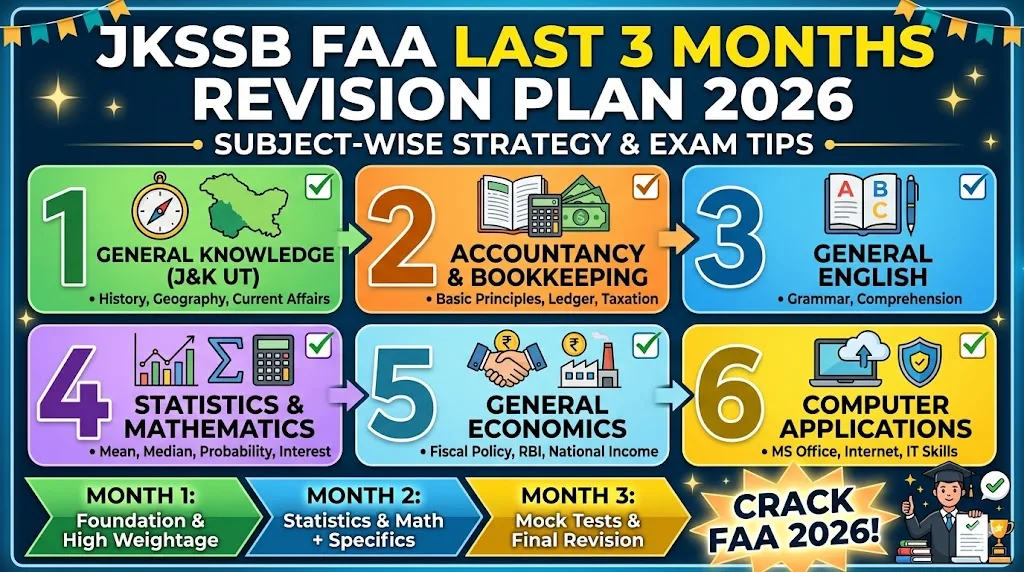
If you’ve been preparing for the JKSSB Finance Accounts Assistant (FAA) exam 2026, you already know how tough this battle is. With over 2 lakh candidates expected to apply for just 600 posts, and the previous exam’s Open Merit cutoff touching 88 out of 120, the margin between selection and rejection is paper-thin.
But here’s the good news — the final three months of preparation are where real rank-jumpers are made. It’s not about reading new books anymore. It’s about sharpening what you already know, fixing your weak spots, and building the speed and accuracy this exam demands.
This article gives you a complete, realistic, week-by-week revision roadmap for the last 90 days before the JKSSB FAA 2026 exam. No fluff, no vague advice — just a clear strategy backed by the latest official syllabus.
Understanding the JKSSB FAA Exam Pattern First
Before you revise, you need to deeply understand what you’re revising for. The JKSSB Finance Accounts Assistant written exam is structured as follows:
| Section | Marks |
|---|---|
| General Knowledge (J&K Focus) | 30 |
| Accountancy & Bookkeeping | 30 |
| Mathematics / Statistics | 15 |
| General English | 15 |
| Economics | 10 |
| Science | 10 |
| Computer Knowledge | 10 |
| Total | 120 |
Key exam details:
- Total Questions: 120 (objective/MCQ format)
- Duration: 2 hours (120 minutes)
- Negative Marking: 0.25 marks per wrong answer
- No interview — selection is 100% based on written merit + document verification
- No calculators allowed inside the exam hall
The biggest takeaway here? General Knowledge and Accountancy together make up 50% of the paper. Any revision plan that doesn’t treat these two as priority #1 is already losing.
Month 1 (Day 1–30): Deep Revision of High-Weightage Sections
Week 1 & 2 — Accountancy & Bookkeeping (30 Marks)
Accountancy is the backbone of the FAA exam, and it’s also the section that separates serious candidates from casual ones. During these two weeks, go back to basics with a sharp focus.
Topics to cover:
- Fundamentals of financial accounting and its concepts
- Journal entries — practice writing at least 20 entries per day
- Ledger accounts and posting rules
- Bank Reconciliation Statements (BRS) — this is a guaranteed question area
- Trial Balance preparation
- Trading Account, Profit & Loss Account, and Balance Sheet
- Depreciation methods — Straight Line Method vs Written Down Value
- Bills of Exchange and promissory notes
- Government accounting basics and PFMS (Public Financial Management System)
- Voucher preparation and verification
Revision tip: Don’t just read theory. Solve numerical problems every single day. Buy a register and manually write journal entries. Muscle memory helps retain accounting rules far better than passive reading.
Week 3 — General Knowledge: J&K Focus (30 Marks)
This section is all about Jammu & Kashmir — its history, geography, governance, economy, and current affairs. Do not underestimate it.
Topics to cover:
- J&K Reorganisation Act, 2019 — know every important clause
- Political and physical divisions of J&K UT
- Important rivers (Jhelum, Chenab, Indus, Ravi, Beas), lakes (Dal, Wular, Pangong), and mountain passes
- J&K economy: horticulture, handicrafts, tourism, hydroelectric power
- Historical events: Dogra rule, accession to India, Article 370 abrogation
- Transport and communication infrastructure
- National and international current affairs from the past 12 months
- Indian culture, heritage sites in J&K (Vaishno Devi, Amarnath, Gulmarg)
- Important personalities from J&K
Revision tip: Maintain a dedicated notebook for J&K GK. Every time you read a newspaper or news app, note down J&K-specific developments. Make flashcards for facts like river lengths, district headquarters, and historical dates.
Week 4 — Mathematics & Statistics (15 Marks)
Many aspirants neglect Math because it feels hard, but with 15 marks at stake and relatively straightforward questions, it’s one of the easiest sections to score well in with proper revision.
Topics to cover:
- Percentages, Profit & Loss, Simple and Compound Interest
- Ratio and Proportion
- Time, Work, and Speed
- Averages and Weighted Averages
- Basic Statistics: Mean, Median, Mode, Standard Deviation
- Data Interpretation (bar graphs, pie charts, tables)
- Number System basics
Revision tip: Spend 45 minutes daily on timed Math practice. Use shortcut methods for percentage calculations and ratio problems — they save precious seconds during the actual exam.
Month 2 (Day 31–60): Strengthening Remaining Sections + Mock Tests
Week 5 — General English (15 Marks)
English is scoring if you approach it right. The questions are typically straightforward.
Topics to cover:
- Reading Comprehension passages — practice 1 passage daily
- Grammar: Tenses, Articles, Prepositions, Subject-Verb Agreement
- Vocabulary: Synonyms, Antonyms, One-Word Substitution
- Sentence correction and error spotting
- Fill in the blanks
- Idioms and Phrases
Revision tip: Read one English newspaper editorial daily — it naturally builds both vocabulary and reading speed. Also attempt at least 20 English MCQs every morning.
Week 6 — Economics (10 Marks) + Science (10 Marks)
These two sections carry 20 marks combined and should not be left for the last minute.
Economics topics:
- Basic concepts: demand, supply, elasticity
- Types of markets: perfect competition, monopoly, oligopoly
- Indian economy: GDP, inflation, fiscal policy, monetary policy
- Economic reforms and liberalization
- Budget basics, direct and indirect taxes
- J&K specific economic data
Science topics:
- Basic Physics: motion, electricity, light
- Chemistry: acids, bases, salts, chemical reactions
- Biology: human body systems, nutrition, diseases
- Environmental science and ecology
- Recent scientific developments and discoveries
Week 7 — Computer Knowledge (10 Marks)
Don’t let this section trip you up — it’s highly scorable.
Topics to cover:
- Fundamentals: hardware, software, input/output devices
- MS Office: Word, Excel, PowerPoint basic operations
- Internet, email etiquette, and browsers
- Computer networking basics: LAN, WAN, MAN
- Cybersecurity basics and data protection
- Operating Systems: Windows basics
- Binary number system and basic data representation
- Database Management concepts
Week 8 — First Full-Length Mock Test Week
By the end of Week 8, you should have completed your first full-length timed mock test under real exam conditions — pen, paper, 120 questions, exactly 2 hours, no phone.
Mock test protocol:
- Attempt mock test on Saturday or Sunday morning
- Review all wrong answers on the following day
- Categorize errors: conceptual mistake, calculation error, or silly mistake
- Update your GK notebook with new facts you missed
- Set targets for improvement before the next mock
Month 3 (Day 61–90): Acceleration, Accuracy & Exam-Mode Training
The Final 30 Days Strategy
This is the phase where many aspirants either break away from the pack or fall behind. The goal now is not to learn new things — it’s to consolidate everything you’ve studied and ensure you can reproduce it fast and accurately under pressure.
Weekly schedule for Month 3:
| Day | Activity |
|---|---|
| Monday | Accountancy revision + 30 MCQs practice |
| Tuesday | GK J&K current affairs + 40 GK MCQs |
| Wednesday | Math/Stats timed practice + English MCQs |
| Thursday | Economics + Science + Computer MCQs |
| Friday | Full syllabus speed revision (notes only) |
| Saturday | Full-length mock test (2 hours, strictly timed) |
| Sunday | Mock test analysis + weak area correction |
High-Priority Topics for the Final Month
Based on previous exam patterns and the current syllabus, here are the most likely high-scoring areas to focus on in the last 30 days:
- BRS and Journal entries — almost always appear in the paper
- J&K Reorganisation Act 2019 — a favourite in GK sections
- PFMS and government accounting — specific to the FAA role
- Depreciation calculations — numerical type, easy marks
- Percentage and ratio problems — quick to solve if practiced
- Computer MS Office questions — straightforward and predictable
- Recent J&K current affairs (last 6 months) — always 4–6 questions
Managing Negative Marking
With 0.25 marks deducted per wrong answer, a careless attempt can turn your 75 into a 70. Here’s a practical rule of thumb:
- Attempt with confidence: If you’re 80%+ sure, go for it.
- Skip wisely: If you genuinely don’t know, skip rather than guess.
- Never leave Accountancy questions unanswered if you’ve prepared — these are your guaranteed marks.
- Use the process of elimination for GK questions where you can narrow down to 2 options.
Revision Resources You Should Use
- For Accountancy: TS Grewal Class 11 & 12 (NCERT-based); previous year JKSSB Accounts Assistant papers
- For GK: Arihant’s Know Your J&K; monthly J&K current affairs magazines
- For Math: R.S. Aggarwal Quantitative Aptitude (selected chapters)
- For Computers: Lucent’s Computer Awareness
- For English: Wren & Martin (grammar chapters); any MBA entrance English practice book
- Mock Tests: Attempt at least 8–10 full-length mocks before exam day
Mental Preparation: The Factor Most Guides Ignore
The JKSSB FAA exam is won as much in your mind as on paper. With a cutoff of 88/120 in the last cycle, even a small mental block on exam day can cost you.
- Sleep at least 7–8 hours every night during the last month
- Avoid starting any completely new topic in the final 2 weeks
- Revise your short notes rather than full textbooks in the last 10 days
- On exam day, start with your strongest section first to build confidence
- Keep 10 minutes at the end to review marked/skipped questions
What the Topper’s Mindset Looks Like
The candidates who crossed 85+ in the 2024 JKSSB Accounts Assistant exam were not necessarily the most “intelligent.” They were the most disciplined and strategic. They covered the entire syllabus at least twice, solved hundreds of MCQs, and treated every mock test seriously.
You have 90 days. That’s 2,160 hours. Used wisely, that’s more than enough time to land your name on the JKSSB FAA merit list.
Start today. Your preparation right now is your biggest competitive advantage.
Frequently Asked Questions (FAQs)
Q1. How many mock tests should I attempt before the JKSSB FAA exam?
Ideally, attempt at least 8–10 full-length mock tests in the last 60 days. Quality of review matters more than quantity of attempts.
Q2. Is the JKSSB FAA syllabus the same as the Accounts Assistant (Finance) syllabus?
Yes — the Finance Accounts Assistant and Accounts Assistant posts share overlapping syllabus areas, particularly in Accountancy and GK.
Q3. Can I crack the JKSSB FAA exam with 3 months of preparation?
Yes, absolutely. Three focused months with a structured timetable, consistent mock tests, and daily MCQ practice is sufficient for a strong score.
Q4. Is there any interview for the JKSSB FAA post?
No. Selection is purely merit-based on the written examination followed by document verification.
Q5. Where can I download the official JKSSB FAA syllabus?
The official syllabus PDF is available at jkssb.nic.in. Always refer to the official notification for the most current version.
Stay consistent, stay disciplined, and trust the process. The JKSSB FAA merit list has space for the prepared.

Zahid Bhat is an education writer with over 6 years of experience covering government jobs, competitive exams, and scholarships across India. He writes for REFE JOB to help students and aspirants — from Jammu & Kashmir to Tamil Nadu — get accurate, free, and timely information about SSC, IBPS, UPSC, JKSSB, and state recruitment boards. Every post is sourced from official notifications and government portals.