
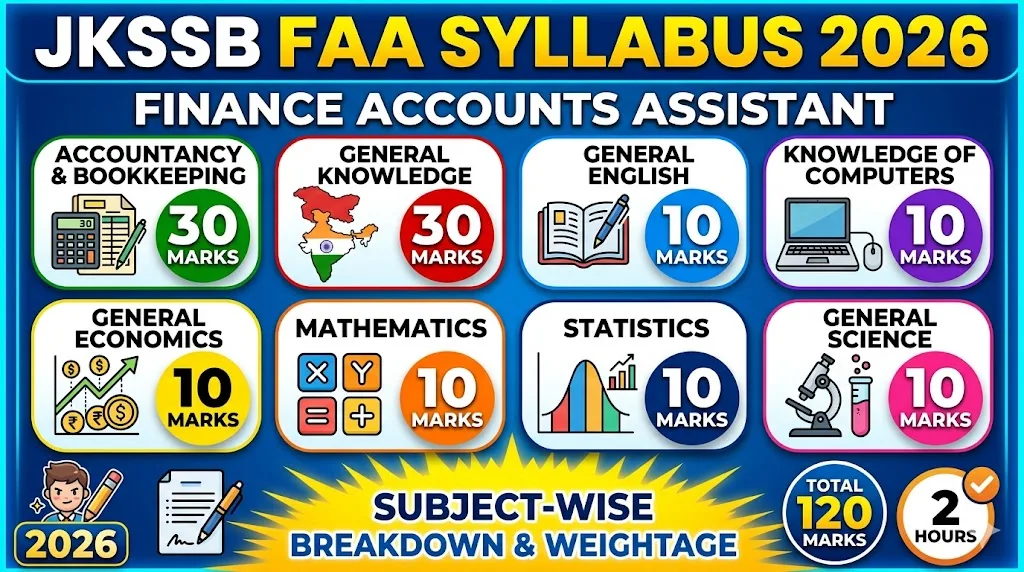
The JKSSB Finance Accounts Assistant (FAA) exam is one of the most sought-after government job examinations in Jammu and Kashmir. With 600 vacancies announced under the Finance Department and lakhs of aspirants competing for a limited number of seats, having a complete understanding of the syllabus is the single most important step you can take before starting your preparation.
This guide gives you the full JKSSB FAA syllabus 2026 — subject by subject, topic by topic — along with the official exam pattern, marking scheme, and a practical preparation strategy that actually works.
What Is the JKSSB Finance Accounts Assistant Post?
The Finance Accounts Assistant (FAA) is a Group C government post under the Finance Department of Jammu and Kashmir. Selected candidates are posted across various government offices and treasuries in the UT and are responsible for maintaining financial records, processing bills, and assisting in budget management.
The post carries an attractive pay under Level 5 of the Pay Matrix, which translates to a starting salary of approximately ₹29,200 per month plus allowances. Given the job security, regular increments, and perks of a permanent government job, the competition for FAA posts is intense.
JKSSB FAA Exam Pattern 2026
| Parameter | Details |
|---|---|
| Mode of Examination | OMR-based offline written exam |
| Type of Questions | Objective type, Multiple Choice Questions (MCQs) |
| Total Questions | 120 |
| Total Marks | 120 |
| Duration | 2 Hours |
| Negative Marking | 0.25 marks deducted per wrong answer |
| Language of Paper | English only |
Key Point: With negative marking at 0.25 per wrong answer, attempting every question blindly will hurt your score. Accuracy matters more than attempting all 120 questions.
JKSSB FAA Syllabus 2026 — All Subjects
- General Knowledge with Special Reference to Jammu and Kashmir
- General English
- Accountancy and Bookkeeping
- Mathematics
- General Science
- Computer Knowledge
- Economics and Statistics
1. General Knowledge (Special Reference to J&K)
This is one of the highest-weightage sections with a strong focus on J&K-specific topics. Do not make the mistake of preparing only general India GK — the J&K portion is specifically tested and often differentiates toppers from average scorers.
- History of Jammu and Kashmir — from Dogra rule to the 2019 reorganisation
- J&K Reorganisation Act 2019 — creation of two Union Territories (J&K and Ladakh)
- Geography of J&K — rivers (Jhelum, Chenab, Ravi), lakes (Dal, Wular, Manasbal), mountain ranges, passes
- Economy of J&K — apple production, horticulture, tourism, hydroelectric power projects
- Important government schemes and flagship programmes for J&K
- Current Affairs (2025–2026) — J&K-specific events, GI tags, infrastructure projects (USBRL project, Banihal-Qazigund tunnel)
- Indian Constitution — especially provisions relevant to Union Territories
- Important national events, appointments, and awards
Preparation Tip: Read one national newspaper daily and follow the official J&K Government website for updates on schemes and projects. Dedicate at least 30 minutes daily to current affairs.
2. General English
- Parts of speech — Nouns, Pronouns, Verbs, Adjectives, Adverbs
- Tenses — Simple, Continuous, Perfect
- Active and Passive Voice
- Direct and Indirect Speech
- Sentence Correction and Error Spotting
- Fill in the Blanks — Articles, Prepositions, Conjunctions
- Vocabulary — Synonyms, Antonyms, One-word substitution, Idioms and Phrases
- Reading Comprehension passages
Preparation Tip: Solve 10–15 grammar-based MCQs daily. Use Wren and Martin for grammar basics and any standard competitive English book for vocabulary.
3. Accountancy and Bookkeeping
This is the most important subject for JKSSB FAA — it carries the highest weightage and is the core competency required for the job. Expect application-based numerical questions in 2026, not just theory.
- Accounting Equation — Assets = Liabilities + Capital
- Double Entry System of Bookkeeping
- Journal Entries — simple and compound
- Ledger Accounts and Posting
- Trial Balance — preparation and purpose
- Bank Reconciliation Statement (BRS)
- Cash Book — single column, double column, petty cash
- Trading and Profit and Loss Account
- Balance Sheet
- Depreciation — Straight Line Method and Written Down Value Method
- Bills of Exchange and Promissory Notes
- Rectification of Errors
- Partnership Accounts — basics of admission and retirement
- Government Accounting concepts
Preparation Tip: Practice at least 8–10 numerical problems daily from Accountancy. Focus especially on BRS, depreciation, and journal entries as these are the most frequently tested.
4. Mathematics
- Number System — LCM, HCF, factors
- Percentage and its applications
- Profit and Loss
- Simple Interest and Compound Interest
- Ratio and Proportion
- Time and Work
- Time, Speed, and Distance
- Averages
- Simplification and Approximation
- Basic Algebra — linear equations
- Mensuration — area and perimeter of basic shapes
Preparation Tip: Practice under timed conditions. Aim to solve each question in under 60 seconds with accuracy.
5. General Science
- Physics — Laws of Motion, Work and Energy, Sound, Light, Electricity
- Chemistry — Elements and Compounds, Acids, Bases and Salts, Metals and Non-metals, Chemical Reactions
- Biology — Cell structure, Nutrition, Respiration, Reproduction, Diseases and their causes
- Environmental Science — Ecosystem, Pollution, Biodiversity
- Science and Technology — Recent inventions, Space programmes (ISRO), Scientific organisations of India
Preparation Tip: NCERT Class 9 and Class 10 Science textbooks are sufficient for this section.
6. Computer Knowledge
- Basic Computer Architecture — Input, Output, Memory, CPU
- Operating Systems — Windows basics, types of OS
- MS Office — Word, Excel, PowerPoint features
- Internet and Email — browsers, search engines, email protocols
- Networking concepts — LAN, WAN, MAN, IP address
- Cyber Security basics — viruses, malware, phishing
- Database basics — what is a database, basic SQL concepts
- Shortcut keys in Windows and MS Office
- Number Systems — Binary, Decimal, Hexadecimal
7. Economics and Statistics
Economics topics:
- Basic economic concepts — demand, supply, elasticity
- National Income — GDP, GNP, NNP concepts
- Indian Economy — five-year plans, economic reforms of 1991
- Budget basics — revenue and capital expenditure, fiscal deficit
- Banking and Finance — Reserve Bank of India functions, types of banks
- J&K Economy — sectors, key industries, government schemes
Statistics topics:
- Measures of Central Tendency — Mean, Median, Mode
- Measures of Dispersion — Range, Standard Deviation, Variance
- Vital Statistics — birth rate, death rate, fertility rates, reproduction rates
- Index Numbers — meaning and types
- Data Interpretation — tables, bar graphs, pie charts
Preparation Tip: Do not ignore Statistics — vital statistics and index numbers are frequently asked. Understand the formulas and practice numerical calculations.
Daily Study Schedule for JKSSB FAA
- Morning (1.5 hours): Accountancy — theory + numericals
- Afternoon (1 hour): GK and Current Affairs
- Evening (1 hour): Alternating between Mathematics, English, Computer, Science, Economics
Important Books for JKSSB FAA Preparation
| Subject | Recommended Book |
|---|---|
| Accountancy | TS Grewal’s Accountancy (Class 11–12), NCERT Accountancy |
| General Knowledge | Manorama Yearbook, Lucent’s GK, J&K specific GK books |
| English | Wren and Martin, RS Aggarwal’s English for Competitive Exams |
| Mathematics | RS Aggarwal’s Quantitative Aptitude |
| Computer Knowledge | Computer Awareness by Arihant Publications |
| General Science | NCERT Class 9 and 10 Science |
Key Dates — JKSSB FAA 2026
Applications for JKSSB FAA 2026 (600 posts) closed on 6 January 2026. The written examination date will be notified on the official website jkssb.nic.in. Candidates who have submitted their applications should regularly check the official website for admit card release, exam date, and result announcements.
Final Word
The JKSSB Finance Accounts Assistant exam is challenging but absolutely crackable with the right preparation. The key is to start early, cover the complete syllabus systematically, and practice numerical subjects (Accountancy and Mathematics) every single day. Candidates who balance theory with regular practice and stay updated on J&K current affairs give themselves the strongest chance of making the merit list.
Bookmark this page and check the official JKSSB website (jkssb.nic.in) regularly for exam date updates and admit card release.

Zahid Bhat is an education writer with over 6 years of experience covering government jobs, competitive exams, and scholarships across India. He writes for REFE JOB to help students and aspirants — from Jammu & Kashmir to Tamil Nadu — get accurate, free, and timely information about SSC, IBPS, UPSC, JKSSB, and state recruitment boards. Every post is sourced from official notifications and government portals.