
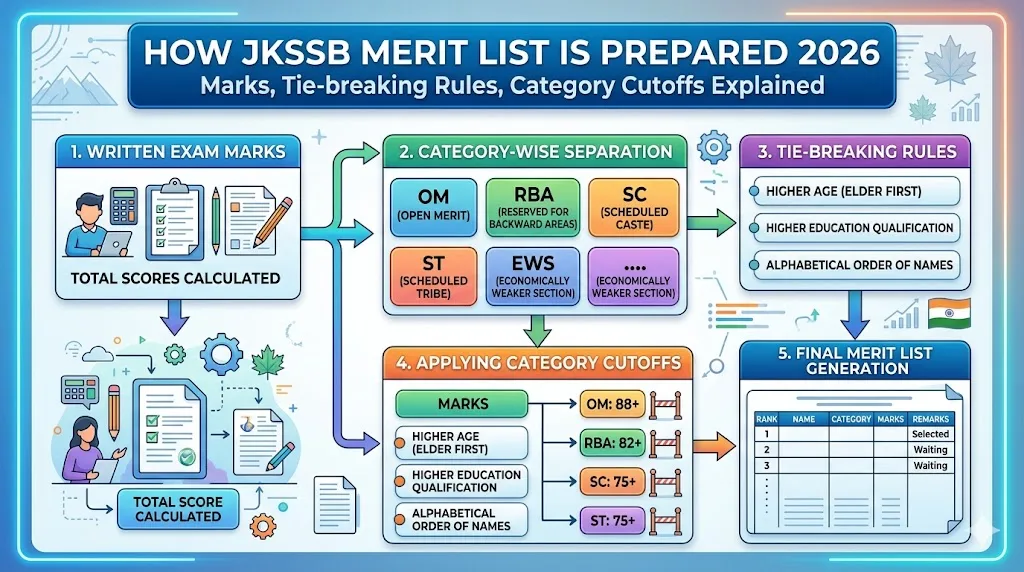
One of the most confusing aspects of JKSSB recruitment for aspirants is understanding how the merit list is prepared. Why do some candidates who scored well not get called for document verification? Why are more candidates called for DV than the number of vacancies? What happens when two candidates score exactly the same marks? This guide answers all these questions in plain language.
Basis of Merit in JKSSB
The JKSSB merit list is prepared strictly on the basis of marks obtained in the written examination. Unlike UPSC or JKPSC (CCE), there is no interview, personality test, or viva for Group C posts. Your written exam score is your final score — nothing else is added.
This makes the process transparent and straightforward: every mark you score in the OMR exam directly impacts your position in the merit list.
How Marks Are Calculated
| Answer Type | Marks |
|---|---|
| Correct Answer | +1 mark |
| Wrong Answer | −0.25 marks (Negative Marking) |
| Question Not Attempted | 0 marks |
Formula: Total Score = (Number of Correct Answers × 1) − (Number of Wrong Answers × 0.25)
Example: If you attempt 100 questions, get 75 correct and 25 wrong:
Score = (75 × 1) − (25 × 0.25) = 75 − 6.25 = 68.75 marks
Because of negative marking, attempting every question is not always the best strategy. A question you are unsure about has a 75% chance of being wrong if you guess randomly among 4 options — which means it is often better to skip it rather than risk losing 0.25 marks.
How the Provisional Merit List Is Drawn
After the written exam, JKSSB arranges candidates in descending order of marks (highest to lowest) within each category. Separate lists are prepared for:
- Open Merit (OM) — all eligible candidates compete
- Scheduled Caste (SC)
- Scheduled Tribe (ST)
- Other Backward Classes (OBC-NCL)
- Residents of Backward Areas (RBA)
- ALC/IB (Actual Line of Control / International Border areas)
- Pahari Speaking People (PSP)
- OSC (Other Social Castes)
- EWS (Economically Weaker Sections)
- Ex-Servicemen (horizontal reservation, applied across categories)
Category Cutoff — How It Works
Each category’s cutoff depends on the score of the last candidate selected from that category. The cutoff is not announced in advance — it depends on the actual scores of all candidates who appeared.
Important: A reserved category candidate who scores above the Open Merit cutoff is counted as an OM candidate, not as a reserved category candidate. This ensures that reserved seats remain for those who actually need them.
Example: If 50 seats are for Open Merit and the 50th-ranked OM candidate scored 72 marks, the OM cutoff is 72. Every candidate below 72 in the OM list does not get selected, regardless of which category they belong to.
How Many Candidates Are Called for DV?
JKSSB calls more candidates for Document Verification than the number of actual vacancies. This is done because:
- Some candidates do not appear for DV
- Some candidates produce incorrect or incomplete documents and are disqualified
- Some candidates are found ineligible based on age or educational qualification after verification
Typically, JKSSB calls candidates from 1x to 1.5x the number of vacancies for DV. If there are 100 vacancies, expect around 100 to 150 candidates to be called for DV initially.
Tie-breaking Rules
When two or more candidates score exactly the same marks in the written examination, JKSSB applies the following criteria to determine ranking:
| Rule | Criteria | Who Ranks Higher |
|---|---|---|
| Rule 1 | Date of Birth | The older candidate (earlier date of birth) |
| Rule 2 (if Rule 1 is equal) | Alphabetical Order (First Name) | Candidate whose name appears first alphabetically |
This means that if you are competing closely with others, your date of birth can be the deciding factor.
Division-wise vs UT-wide Vacancies
For some JKSSB posts, vacancies are announced separately for Jammu Division and Kashmir Division. In this case, candidates compete only within their applied division. For other posts, vacancies are UT-wide — all candidates compete in a single common merit list regardless of division.
Always read the recruitment notification carefully to understand whether the post is division-specific or UT-wide. This information is typically in the first two pages of the official advertisement.
Why You Might Not Get Selected Even After Clearing the Cutoff
- Domicile Certificate Issues: Not issued by a competent authority, or issued after the cut-off date
- Category Certificate Problems: Incorrect format or issued by an officer not authorised to issue it
- Educational Qualification Mismatch: Degree does not exactly match the post requirement
- Age Proof Issues: Class 10 certificate shows a different date of birth than the application form
- Absence from DV: Missing the DV date means automatic disqualification — there is no second chance
- Merit Shift After Objection Resolution: If JKSSB revises scores upward after answer key objections, the cutoff can rise, affecting your relative position
How to Check Your Merit Position
After JKSSB declares results and provisional merit lists, you can check your position on jkssb.nic.in. The provisional merit list is typically uploaded as a PDF showing roll numbers, names, and scores of candidates arranged by rank.
If you believe there is an error in your score, JKSSB provides a window to raise score-related objections after result declaration.
Final Word
The JKSSB merit system is designed to be fully transparent and objective. Your written exam performance decides everything. Understanding how the merit list is constructed, how categories and tie-breaking work, and why candidates get disqualified at DV will help you prepare not just for the exam — but for the entire selection process.
Keep your documents ready, understand your category correctly, and aim for the highest possible score in the written exam. Check jkssb.nic.in regularly for all official updates.

Zahid Bhat is an education writer with over 6 years of experience covering government jobs, competitive exams, and scholarships across India. He writes for REFE JOB to help students and aspirants — from Jammu & Kashmir to Tamil Nadu — get accurate, free, and timely information about SSC, IBPS, UPSC, JKSSB, and state recruitment boards. Every post is sourced from official notifications and government portals.