
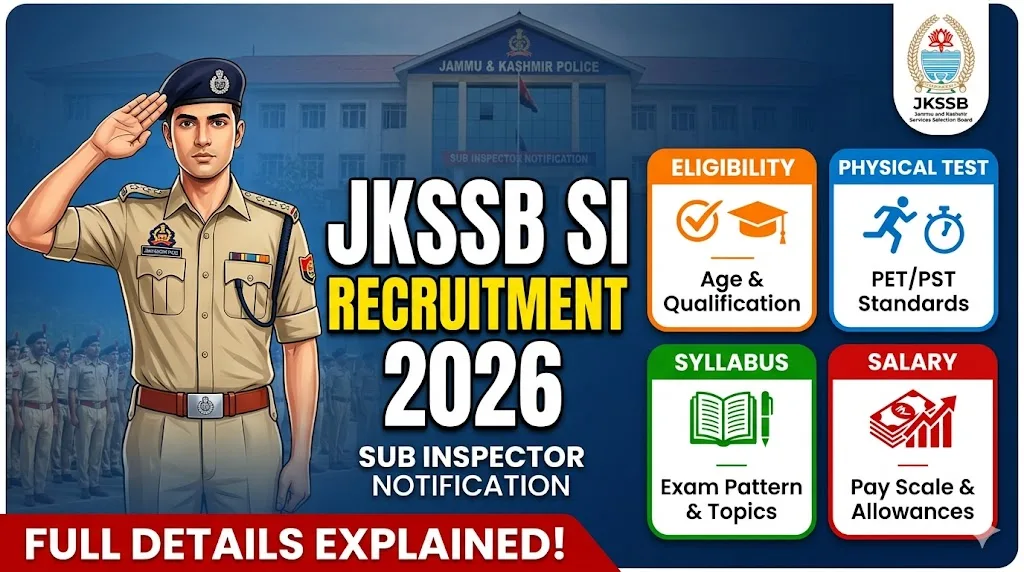
The Sub Inspector (SI) post in the Jammu and Kashmir Police is one of the most competitive and prestigious government positions in the UT. Every year, thousands of graduates apply for SI vacancies — and the competition is fierce because the post comes with authority, respect, and one of the better salary packages in Group B government service.
This guide covers everything you need to know about JKSSB Sub Inspector (SI) recruitment 2026 — eligibility, physical standards, exam pattern, syllabus, selection process, and how to prepare.
About the Sub Inspector Post in J&K Police
A Sub Inspector (SI) in J&K Police is a junior-level officer responsible for managing a police station or beat area, investigating cases, maintaining law and order, and supervising Constables and Head Constables. The SI operates under the supervision of an Inspector and reports to the Circle Officer (Deputy Superintendent of Police). Selected candidates undergo training at the Jammu and Kashmir Police Academy in Udhampur before deployment.
Eligibility Criteria
| Criteria | Details |
|---|---|
| Educational Qualification | Bachelor’s Degree (Graduation) in any discipline from a recognised university — obtained on or before the cut-off date |
| Domicile | Valid J&K UT Domicile Certificate — mandatory |
| Age — General | 18 to 28 years (stricter than most other JKSSB posts) |
| Age Relaxation — SC/ST | 5 years (upper age becomes 33 years) |
| Age Relaxation — OBC/RBA | 3 years (upper age becomes 31 years) |
| Height — Male General | Minimum 165 cm |
| Height — Female General | Minimum 155 cm |
| Chest — Male (unexpanded) | Minimum 78 cm |
| Chest — Male (expanded) | Minimum 83 cm (5 cm expansion mandatory) |
Selection Process
| Stage | Name | Type |
|---|---|---|
| Stage 1 | Written Examination (OMR-based MCQ) | Merit-based — decides final rank |
| Stage 2 | Physical Measurement Test (PMT) | Qualifying only — height, weight, chest |
| Stage 3 | Physical Efficiency Test (PET) | Qualifying only — running test |
| Stage 4 | Document Verification (DV) | Qualifying — document check |
| Stage 5 | Medical Examination | Qualifying — health fitness |
| Stage 6 | Final Merit List and Appointment | Appointment by department |
Physical Efficiency Test (PET) Standards
| Category | Task | Time Limit |
|---|---|---|
| Male Candidates | 1600 metre run | Must complete within 6 minutes 30 seconds |
| Female Candidates | 800 metre run | Must complete within 4 minutes |
There is no relaxation in PET timings for any category. Start physical training at least 4–6 months before the exam. Many academically strong candidates fail at the PET stage due to lack of physical preparation. Treat the PET as seriously as the written exam.
Written Exam Pattern
| Parameter | Details |
|---|---|
| Mode | OMR-based offline objective exam |
| Total Questions | 120 |
| Total Marks | 120 |
| Duration | 2 hours |
| Negative Marking | 0.25 marks per wrong answer |
| Medium | English |
Syllabus — Subject-wise
1. General Knowledge (Special Reference to J&K)
- History of J&K — Dogra period, accession to India, Article 370, J&K Reorganisation Act 2019
- Geography of J&K — districts, divisions, rivers, passes, wildlife sanctuaries
- J&K Police — structure, ranks, major operations, modernisation initiatives
- J&K Administration — Lieutenant Governor system, administrative departments
- Current Affairs (2025–2026) — J&K-specific: new appointments, security developments, government schemes
- Indian Constitution — Fundamental Rights, criminal law provisions, police powers under CrPC
- Important national events, sports, science and technology
2. General English
- Grammar — Tenses, Voice, Narration, Sentence Correction
- Vocabulary — Synonyms, Antonyms, One-word Substitution
- Fill in the Blanks — articles, prepositions, conjunctions
- Reading comprehension passages
- Idioms and phrases
3. General Science and Technology
- Physics — Motion, Force, Energy, Light, Sound, Electricity
- Chemistry — Acids, Bases, Salts; Metals and Non-metals; Chemical Reactions
- Biology — Human body systems, diseases, nutrition
- Science in daily life — common inventions, scientific phenomena
- Recent technology developments — space programmes, defence technology, ISRO
4. Mathematics and Reasoning
- Number System, Percentage, Profit and Loss
- Simple and Compound Interest, Ratio and Proportion
- Time and Work, Time Speed Distance, Mensuration, Averages
- Reasoning — Series, Coding-Decoding, Analogy, Blood Relations, Direction and Distance, Syllogisms, Data Interpretation
5. Law and Criminal Procedure — Key Section for SI
This section is unique to the SI exam. Most candidates skip it — giving well-prepared candidates a significant advantage of 10–15 extra marks.
| Law Subject | Key Topics to Prepare |
|---|---|
| Indian Penal Code (IPC) | Crimes against persons and property, criminal conspiracy, offences by public servants |
| Code of Criminal Procedure (CrPC) | FIR registration, arrest procedures, bail, cognisable and non-cognisable offences, powers of police |
| Indian Evidence Act | Admissibility of evidence, types of evidence, confessions |
| J&K Police Act | Structure, duties, and powers of police in the UT |
| Cyber Crime — IT Act | Types of cyber offences, reporting mechanisms |
| Rights of Arrested Persons | Right to know grounds of arrest, legal aid, production before magistrate within 24 hours |
6. Computer Knowledge
- Computer basics, MS Office, Internet, Cyber Security
- Networking fundamentals — LAN, WAN, IP address
- Common shortcut keys in Windows and MS Office
Salary
| Component | Amount |
|---|---|
| Pay Level | Level 6 of J&K Pay Matrix |
| Basic Pay | ₹35,400 per month |
| Effective CTC (with DA + HRA + Allowances) | Approximately ₹50,000 – ₹58,000 per month |
| Additional Benefits | Uniform allowance, vehicle allowance (selected postings), annual increment |
| Promotion Prospect | Inspector → Deputy Superintendent of Police (through departmental channel) |
Police Training After Selection
After appointment, Sub Inspectors undergo mandatory training at the J&K Police Academy, Udhampur — typically 9 to 12 months covering physical training, law subjects (IPC, CrPC, J&K Police Act), weapons training, traffic management, crowd control, and field postings. A 2-year probation period follows training before confirmation in the post.
Preparation Strategy
Physical Preparation (Start Immediately)
- Begin running daily — 2 to 4 km per day initially, building up to 4 to 6 km
- Include sprint training in the final 2 months before the exam
- Practice bodyweight exercises — push-ups, sit-ups, pull-ups for overall fitness
- If chest size needs improvement, start specific exercises (bench press, cable fly) at least 4 months in advance
Academic Preparation
- Law section (IPC, CrPC) — most candidates skip it; mastering it gives 10–15 extra marks. Make this a priority.
- J&K-specific GK and current affairs — dedicate at least 30 minutes daily
- Mathematics and Reasoning — daily practice under timed conditions
- Attempt full-length mock tests from 2 months before the exam date
- Analyse every wrong answer and revise the concept before the next test
Documents Required for SI DV
- J&K UT Domicile Certificate (from competent authority)
- Graduation Degree Certificate and Marksheets
- Class 10 Certificate (for date of birth proof)
- Category Certificate (if applicable)
- Character Certificate from a Gazetted Officer
- JKSSB Application Form printout
- Passport-size photographs (4–6 copies)
- Valid Photo ID — Aadhaar card, Voter ID, Passport, or Driving Licence
Final Word
The JKSSB Sub Inspector post requires a dual preparation strategy — physical fitness and academic competence. Many candidates neglect one or the other and fail at an avoidable stage. The law section (IPC, CrPC) is a hidden advantage that most aspirants do not study seriously — mastering it can give you 10 to 15 extra marks that directly improve your merit position.
Start both your physical training and academic preparation today, and check jkssb.nic.in regularly for the latest SI notification and exam date.

Zahid Bhat is an education writer with over 6 years of experience covering government jobs, competitive exams, and scholarships across India. He writes for REFE JOB to help students and aspirants — from Jammu & Kashmir to Tamil Nadu — get accurate, free, and timely information about SSC, IBPS, UPSC, JKSSB, and state recruitment boards. Every post is sourced from official notifications and government portals.