
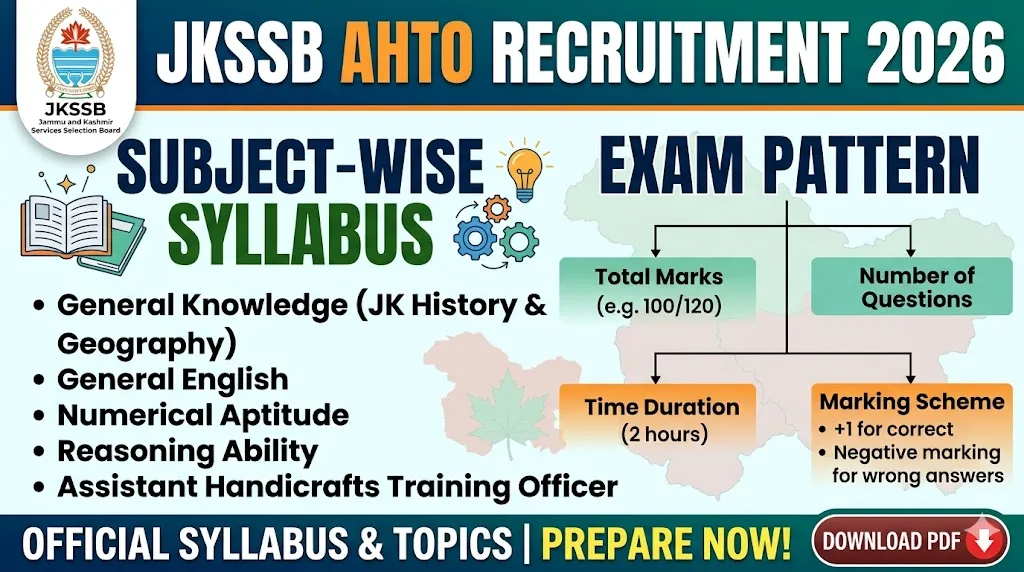
JKSSB AHTO Syllabus 2026: The Jammu and Kashmir Services Selection Board (JKSSB) has invited applications for the post of Assistant Handicrafts Training Officer / Assistant Handloom Training Officer (AHTO) under the Department of Handicrafts and Handloom. If you’re one of the aspirants preparing for this exam, this article breaks down the subject-wise syllabus, the exact exam pattern, and a practical section-by-section strategy to help you plan your last few weeks of revision.
I’ll be honest about one thing upfront: notification numbers and vacancy counts for AHTO have been reported slightly differently across different portals this cycle. Before you start preparing, open the official JKSSB notification PDF at jkssb.nic.in and confirm the exact advertisement number, vacancy count, and application deadline for your case. The syllabus and exam pattern below, however, are consistent across all official sources and previous AHTO recruitment cycles.
What is the JKSSB AHTO Post?
The Assistant Handicrafts Training Officer / Assistant Handloom Training Officer is a Class III (gazetted/non-gazetted, depending on cadre) post under the Handicrafts and Handloom Department, Jammu and Kashmir. The role typically involves supervising and training artisans, overseeing skill-development programs, and supporting the documentation and promotion of traditional Kashmiri craft and weaving techniques at the field level.
Because this is a graduate-level post recruited through JKSSB, the written examination follows the same general-pattern structure used for most JKSSB graduate-level posts, rather than a separate technical paper. This is actually good news for aspirants — if you’ve already been preparing for Junior Assistant, Patwari, or Finance Accounts Assistant exams, a large part of your preparation directly carries over to AHTO.
JKSSB AHTO Exam Pattern 2026
The written test for AHTO is an Objective Type, OMR/CBT-based examination consisting of six sections, each carrying equal weight. Here’s the structure:
| Section | Marks | Approx. Questions |
|---|---|---|
| General English | 20 | 20 |
| General Awareness & Current Affairs | 20 | 20 |
| General Knowledge — J&K Specific | 20 | 20 |
| General Science | 20 | 20 |
| Mental Ability / Reasoning | 20 | 20 |
| Computer Applications | 20 | 20 |
| Total | 120 | 120 |
- Total duration: 120 minutes
- Question type: Multiple Choice Questions (MCQs)
- Negative marking: 0.25 marks deducted per wrong answer (standard across recent JKSSB graduate-level exams — confirm in your specific notification)
- Mode: OMR-based offline test (recent JKSSB exams have largely followed this format; check your admit card for the confirmed mode)
After the written test, technical posts like AHTO often involve an additional document verification stage, and depending on the specific recruitment rules notified for this post, a skill or trade-related assessment may also apply. This part varies by notification, so check the “Selection Process” section of your specific AHTO advertisement carefully.
JKSSB AHTO Syllabus 2026 — Subject-Wise Topics
1. General English
This section tests grammar fundamentals and comprehension rather than literature. Expect questions from:
- Tenses and verb forms
- Rearrangement of jumbled sentences
- Narration (direct and indirect speech)
- Modals and articles
- Comprehension passages with fill-in-the-blanks
- Phrases, idioms, and clauses
- Pronouns and prepositions
- Homonyms and homophones
- Synonyms and antonyms
- One-word substitutions
How to prepare: NCERT English grammar books for classes 8–10 cover almost all of this. Spend 20–25 minutes daily solving previous-year JKSSB English questions rather than re-reading grammar rules — this section rewards pattern recognition more than memorization.
2. General Awareness & Current Affairs
This section covers national and international current events along with static GK. Focus areas typically include:
- National and international news from the past 6–12 months
- Government schemes and policies (central)
- Sports, awards, and honours
- Important days and events
- Books and authors
- Banking and economy basics (RBI, monetary policy, taxation)
How to prepare: Read one national daily regularly and maintain a monthly current affairs notebook. Avoid jumping between too many YouTube channels for this — pick one reliable monthly compilation and revise it weekly instead of consuming new content daily.
3. General Knowledge — J&K Specific
This is the highest-scoring opportunity for local aspirants, since it rewards depth rather than breadth. Core topics include:
- History, geography, and culture of Jammu & Kashmir
- J&K Reorganization Act, 2019, and constitutional changes
- Administrative structure, districts, and divisions of J&K
- J&K-specific government schemes and welfare programs
- Handicrafts, handloom traditions, and Geographical Indication (GI) tags of J&K crafts
- Important personalities and institutions of J&K
- Recent J&K current affairs and government notifications
How to prepare: Given that AHTO sits under the Handicrafts & Handloom Department, it’s worth reading a bit deeper into J&K’s GI-tagged crafts (Pashmina, Kani shawl, Sozni embroidery, papier-mâché, and walnut wood carving, among others) and the department’s recent schemes — these occasionally show up as J&K GK questions even when there’s no dedicated technical paper.
4. General Science
Questions are drawn from school-level Physics, Chemistry, and Biology — nothing beyond Class 10 NCERT depth. Common areas:
- Basic physics: motion, light, sound, electricity
- Basic chemistry: elements, compounds, common reactions
- Human biology: organ systems, diseases, nutrition
- Environmental science basics
- Recent scientific developments in the news
How to prepare: NCERT Science textbooks (classes 6–10) remain the single best resource. Don’t go beyond this level — JKSSB science questions are consistently school-level, not competitive-exam-level.
5. Mental Ability / Reasoning
This section tests logical and analytical thinking and is one of the fastest to improve with consistent daily practice. Topics include:
- Number series and coding-decoding
- Analogies and classification
- Blood relations
- Direction sense
- Seating arrangement and puzzles
- Basic mathematics: percentages, ratios, averages, simple/compound interest, time and work
How to prepare: Solve at least 20 reasoning questions daily under timed conditions. This section has the best marks-per-minute return if you practice consistently, since the question types repeat heavily across JKSSB exams.
6. Computer Applications
With most government departments now digitized, this section checks practical digital literacy rather than deep technical knowledge:
- Basics of computer hardware and software
- MS Office — primarily MS Word and MS Excel
- Internet basics, browsers, and search engines
- Email etiquette and protocols
- Basic cybersecurity and data safety concepts
- Operating system fundamentals
How to prepare: If you’ve used MS Office for basic document and spreadsheet work, you already know 70% of this section. Spend your time only on the unfamiliar 30% — shortcut keys, email protocol terms (SMTP, IMAP, POP3), and basic security terms.
Section-Wise Preparation Strategy
With six sections of equal weight and limited time before the exam, prioritization matters more than trying to cover everything equally. Here’s a practical approach:
- Start with J&K GK and Mental Ability — together these can secure 35–40 marks relatively quickly since both reward focused, repeatable practice.
- Lock in Computer Applications early — it’s a small, finite syllabus that doesn’t need ongoing revision once covered.
- Treat General Science as a quick NCERT revision task, not a deep-study subject — most aspirants over-invest time here relative to the marks available.
- Build current affairs as a daily habit, not a last-minute cram — this section punishes irregular preparation the most.
- Practice English daily in short bursts rather than long sessions — grammar retention improves with frequency, not duration.
Given the 0.25 negative marking, accuracy matters as much as speed. With 120 questions in 120 minutes, you have exactly one minute per question — but in practice, you should aim to finish the sections you’re strongest in within 35–40 minutes total, leaving extra time for sections like General Science or English comprehension where careful reading reduces careless mistakes.
Best Resources for JKSSB AHTO Preparation
- NCERT textbooks (classes 6–10) for Science and English grammar
- A J&K-focused current affairs monthly compilation
- Previous-year JKSSB question papers — Junior Assistant, Patwari, and FAA papers are good practice since the pattern overlaps heavily
- A reasoning practice book covering basic mental ability topics
- Department of Handicrafts & Handloom J&K’s official notifications, for any updates specific to AHTO recruitment
Frequently Asked Questions
Q1. What is the total marks for the JKSSB AHTO written exam?
The written test carries 120 marks in total, split equally across six sections of 20 marks each.
Q2. Is there negative marking in the JKSSB AHTO exam?
Yes, a deduction of 0.25 marks typically applies for each wrong answer, consistent with recent JKSSB graduate-level exams. Confirm this in your specific notification before the exam.
Q3. Does the AHTO syllabus include a separate Handicraft/Handloom technical paper?
Based on the officially notified syllabus, the written test covers general sections (English, GK, Science, Reasoning, Computer Applications) rather than a dedicated technical paper. Depending on your specific recruitment notification, a separate skill or document verification stage may follow the written test — check your advertisement for confirmation.
Q4. How long is the JKSSB AHTO exam?
The exam duration is 120 minutes for 120 questions.
Q5. Is the JKSSB AHTO syllabus similar to other JKSSB graduate-level posts?
Yes, the section structure closely mirrors other JKSSB graduate-level exams like Junior Assistant and Patwari, particularly in English, Computer Applications, and J&K GK. If you’ve prepared for those exams, much of that preparation directly applies here.
Q6. Where can I download the official JKSSB AHTO syllabus PDF?
Always download the syllabus directly from the official JKSSB website, jkssb.nic.in, under the relevant notification for the AHTO post, to ensure you’re studying the exact version applicable to your recruitment cycle.
If you found this breakdown useful, bookmark this page — we’ll update it as soon as JKSSB releases the exam date and admit card for AHTO. For structured mock tests and topic-wise practice covering this exact pattern, check out Chinar Classes’ JKSSB preparation material.

Zahid Bhat is an education writer with over 6 years of experience covering government jobs, competitive exams, and scholarships across India. He writes for REFE JOB to help students and aspirants — from Jammu & Kashmir to Tamil Nadu — get accurate, free, and timely information about SSC, IBPS, UPSC, JKSSB, and state recruitment boards. Every post is sourced from official notifications and government portals.