
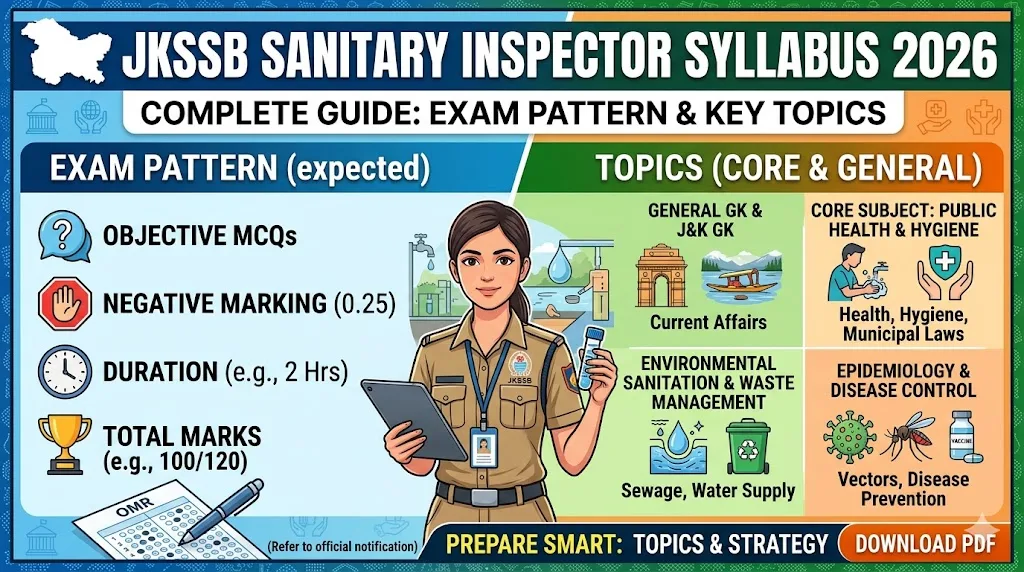
JKSSB Sanitary Inspector Syllabus 2026: The post of Sanitary Inspector under the Jammu and Kashmir Health & Medical Education Department is one of the more technical roles recruited through JKSSB — it combines the standard general-knowledge syllabus used across most JKSSB Class III posts with a dedicated public health and sanitation paper. This article breaks down both parts, the exam pattern, and how to prioritize your preparation.
Before you start preparing, download the official syllabus PDF from jkssb.nic.in for the specific advertisement notification under which you’ve applied. JKSSB has issued syllabi for Health & Medical Education Department posts as multiple annexures within a single notification, and the exact mark distribution between the general and technical sections can vary slightly by cycle — always confirm the figures against your own notification before finalizing your study plan.
About the JKSSB Sanitary Inspector Post
A Sanitary Inspector is essentially a paramedical field officer responsible for maintaining public health standards — monitoring sanitation, water quality, food hygiene, and waste disposal practices in their assigned area, while also supporting broader public health and disease-prevention activities under the Health & Medical Education Department.
Because this is a technical/paramedical post, the written exam isn’t purely general-knowledge based like many other JKSSB roles — it includes a dedicated section testing your understanding of human physiology, food safety, and sanitation engineering basics, alongside the standard general syllabus.
JKSSB Sanitary Inspector Exam Pattern 2026
- Mode: Objective Type, OMR-based written test
- Question type: Multiple Choice Questions (MCQs)
- Structure: A general syllabus component (English, Maths, History, Civics, Geography, Science, GK & Current Affairs, J&K GK, Mental Ability) plus a technical/professional component specific to public health and sanitation
- Negative marking: Applies as per JKSSB’s standard policy for graduate/technical-level posts — confirm the exact deduction value in your notification, as it has varied between 0.25 and 0.50 across different posts in recent cycles
Note: the combined total marks and the exact weightage split between the general and technical sections aren’t uniformly published across available sources for this cycle. Treat the section-wise marks below as a guide to topic coverage and priority, and cross-check the final numbers against your official syllabus PDF.
Part 1: General Syllabus (Common Section)
This portion mirrors the general syllabus used across most JKSSB graduate-level technical posts, organized into the following units:
| Unit | Subject | Approx. Marks |
|---|---|---|
| I | General English | 20 |
| II | Mathematics | 17 |
| III | History | 10 |
| IV | Civics | 10 |
| V | Geography | 10 |
| VI | General Science | 17 |
| VII-A | General Knowledge & Current Affairs | 13 |
| VII-B | General Knowledge — J&K Specific | 10 |
| VIII | Mental Ability Test | 13 |
Unit I: General English
- Paragraph writing and comprehension
- Editing and proofreading
- Rearranging jumbled sentences
- Narration and dialogue
- Modals and articles
- Fill-in-the-blanks with phrases, pronouns, homonyms, and tenses
- Clauses and punctuation
- Synonyms, antonyms, and idioms
- Use of prepositions
Unit II: Mathematics
- Surface areas and volumes of solids (cubes, cuboids, spheres, cylinders, cones)
- Conversion of solids and frustum of a cone
- Profit and loss
- Simple and compound interest
- Linear equations in two variables
- Progressions and BODMAS
- Basic probability
Unit III: History
- Revolt of 1857 — causes and effects
- Rise of the national movement and formation of the Indian National Congress
- Partition of Bengal and rise of extremism in Congress
- Boycott and Swadeshi Movement
- Rise of the Muslim League, Khilafat Movement, Non-Cooperation Movement
- Quit India Movement, Independence, and Partition
Unit IV: Civics
- Fundamental Rights, Duties, and Directive Principles
- Democracy — types, public opinion, representation
- Elections — franchise, secret ballot, nomination, symbols, campaigns
- The United Nations
Unit V: Geography
- Seasons, planets, solar system, latitude-longitude
- Forests and conservation, with J&K-specific reference
- National parks and wildlife sanctuaries of J&K
- Water resources, rainwater harvesting, and transport routes of J&K
Unit VI: General Science
- Gravitation, heat, light, matter, acids, salts, elements, cells
- Conventional and non-conventional energy sources
- Physical and chemical properties of metals and non-metals
- Life processes — nutrition, respiration, transportation, excretion
- Environmental pollution, ecosystems, food chains and webs
- Ozone depletion and the greenhouse effect
- Mendel’s experiments and reproduction in plants and animals
Unit VII: General Knowledge & Current Affairs
- National and international current events, abbreviations, important dates
- Books and authors, geographical discoveries, awards and honours
- UN and other international organisations (SAARC, ASEAN, BRICS, G7)
- India’s space and atomic research programs
- India’s GDP, per capita income, and major power plants
- J&K specific: constitutional history, centre-state relations, weather and crops, rivers and lakes, tourist destinations, flora and fauna
Unit VIII: Mental Ability Test
- Number and letter series, coding-decoding
- Direction sense and blood relations
- Mathematical reasoning, speed-distance-time
- Statements and conclusions
Part 2: Technical Syllabus — Public Health & Sanitation
This is what separates the Sanitary Inspector exam from most other JKSSB posts. The technical section tests core paramedical and public-health knowledge relevant to fieldwork:
1. Human Anatomy, Physiology & Pathology
- Cell structure, tissues, and the skeletal system
- Composition and function of blood, the lymphatic system, and the heart
- Respiratory, urinary, nervous, and digestive systems
- Endocrine glands and hormones
- Reproductive system physiology
- Cell growth, tumors (benign vs. malignant), and the basics of cancer spread
2. Food Microbiology & Food Hygiene
- General principles of food hygiene
- Microbiological contamination and food safety basics
- Food-borne diseases and prevention
3. Food Chemistry & Nutrition
- Basic principles of food chemistry
- Role of nutrition in human health
4. Liquid Waste Management
- Classification and quality of different types of liquid waste
- Health hazards of improper disposal
- Sanitary sewerage systems
5. Night Soil Disposal & Sanitation
- Hazards of insanitary disposal practices
- Types of latrines: borehole, dug well, RCA, and septic tank systems
- Sanitation of trenching grounds
If your specific syllabus PDF lists additional technical units (such as water supply and treatment, vector-borne disease control, or solid waste management), treat the topics above as the confirmed core and add the rest from your official document — the technical syllabus can be expanded slightly depending on the exact notification under which you’ve applied.
Preparation Strategy
- Don’t neglect the technical section. Many aspirants focus only on the general syllabus since it’s familiar from other JKSSB exams, but the anatomy/physiology and sanitation topics are unique to this post and often less competitive ground for everyone — a real opportunity to gain an edge.
- Build the technical portion from NCERT Class 10-12 Biology for anatomy and physiology basics, then layer on specific public-health and sanitation concepts using standard paramedical/Sanitary Inspector reference material.
- Use Mental Ability and J&K GK as quick-win sections in the general syllabus — both reward consistent daily practice over deep study.
- Treat History, Civics, and Geography as light revision subjects — they carry fewer marks individually, so don’t over-invest time relative to their weightage.
- Practice previous-year papers for similar Health & Medical Education Department posts (Junior Sanitary Inspector, Para Medical Staff, MPHW) since question patterns and difficulty levels tend to overlap closely.
Frequently Asked Questions
Q1. Does the JKSSB Sanitary Inspector exam have a separate technical paper?
Yes. Unlike many other JKSSB posts, Sanitary Inspector includes a dedicated technical section covering human anatomy and physiology, food hygiene and microbiology, food chemistry, liquid waste management, and sanitation/night soil disposal, in addition to the general syllabus.
Q2. What subjects are covered in the general syllabus section?
The general section covers English, Mathematics, History, Civics, Geography, General Science, General Knowledge & Current Affairs, J&K-specific GK, and Mental Ability — the same structure used across most JKSSB graduate-level technical posts.
Q3. Is the JKSSB Sanitary Inspector exam OMR-based or computer-based?
Most JKSSB written exams in this cycle are conducted as OMR-based offline tests. Confirm the exact mode from your admit card closer to the exam date.
Q4. Is there negative marking in the JKSSB Sanitary Inspector exam?
Negative marking applies as per JKSSB’s standard policy for the relevant post category, though the exact deduction value has varied between different recent recruitments. Always confirm this from your specific notification before the exam.
Q5. Where can I download the official JKSSB Sanitary Inspector syllabus PDF?
Always download the syllabus directly from the official JKSSB website, jkssb.nic.in, under the relevant Health & Medical Education Department notification, to ensure you’re studying the exact version and mark distribution applicable to your recruitment cycle.
Bookmark this page for updates as JKSSB releases the confirmed exam date and admit card for Sanitary Inspector. For structured practice covering both the general and technical sections, check out Chinar Classes’ JKSSB preparation material.

Zahid Bhat is an education writer with over 6 years of experience covering government jobs, competitive exams, and scholarships across India. He writes for REFE JOB to help students and aspirants — from Jammu & Kashmir to Tamil Nadu — get accurate, free, and timely information about SSC, IBPS, UPSC, JKSSB, and state recruitment boards. Every post is sourced from official notifications and government portals.