
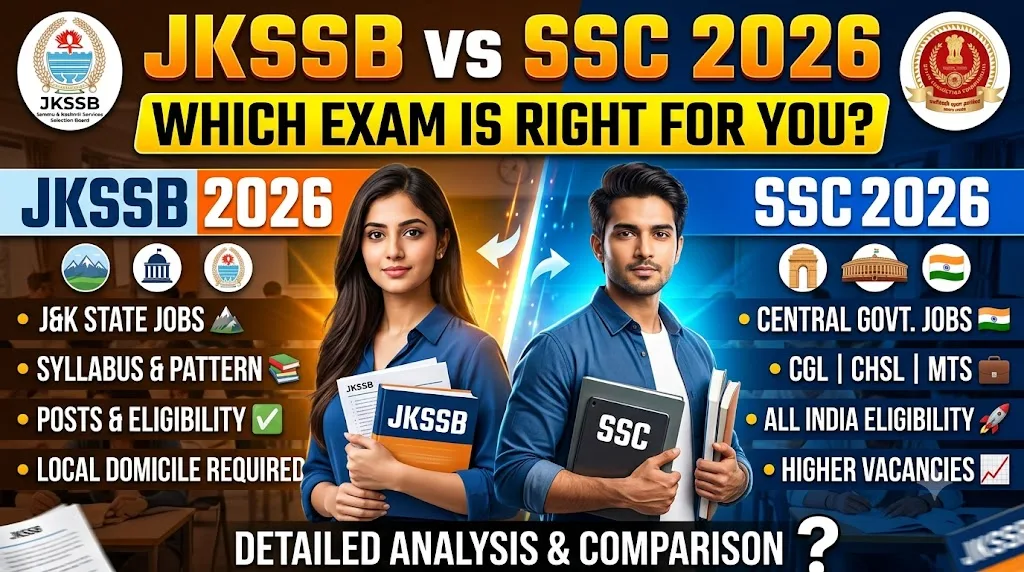
Every year, thousands of young aspirants in Jammu & Kashmir face a crossroads: should they focus on JKSSB exams or prepare for SSC at the national level? Both paths promise a government job, a stable salary, and long-term career security. But the two are very different in scope, competition, syllabus, and what they ultimately offer.
If you are sitting in Srinagar, Jammu, or any district of the Union Territory and wondering which direction to take your preparation in 2026, this guide breaks it all down for you — honestly and clearly. There is no single right answer, because the best choice depends on your location preference, your academic background, your competitive strength, and your long-term goals. What matters is making an informed decision rather than following the crowd.
Let us walk through everything you need to know before picking your path.
What Is JKSSB?
The Jammu and Kashmir Services Selection Board (JKSSB) is the official body responsible for recruiting candidates for Class IV and Class III (non-gazetted) posts in various government departments of the Union Territory of Jammu and Kashmir. It was restructured after the reorganization of J&K in 2019 and has since been one of the most active recruitment boards in the region.
JKSSB recruits for posts like Junior Assistant, Accounts Assistant, Sub-Inspector, Junior Engineer, Patwari, Forest Guard, and dozens of other department-specific roles. Most of these positions are domicile-based, meaning only J&K domicile holders are eligible to apply.
In 2026, JKSSB is expected to release multiple recruitment notifications covering hundreds to thousands of vacancies across health, revenue, finance, education, police, and public works departments.
What Is SSC?
The Staff Selection Commission (SSC) is a central government body that recruits staff for various ministries, departments, and organizations under the Government of India. SSC conducts some of the most competitive exams in the country, including:
- SSC CGL (Combined Graduate Level) — for Group B and Group C posts
- SSC CHSL (Combined Higher Secondary Level) — for 10+2 pass candidates
- SSC MTS (Multi Tasking Staff) — for matriculation-level candidates
- SSC GD Constable — for constable posts in central armed police forces
- SSC CPO — for Sub-Inspector in Delhi Police and CAPF
SSC postings are all-India in nature. Candidates can be posted anywhere in the country, though they can indicate preferences. Hundreds of thousands of candidates from across India compete for SSC vacancies every year, making it one of the toughest battlegrounds in the government job market.
Key Differences Between JKSSB and SSC 2026
Before diving deeper, here is a clear side-by-side comparison of the two:
| Feature | JKSSB | SSC |
|---|---|---|
| Conducting Body | J&K Services Selection Board | Staff Selection Commission (Central Govt.) |
| Level | Union Territory (J&K specific) | National Level |
| Eligibility – Domicile | J&K Domicile mandatory | Open to all Indian citizens |
| Medium of Exam | English/Urdu/Hindi | English and Hindi |
| Posting Location | Within J&K only | All India (preference-based) |
| Competition Level | Regional (moderate to high) | National (very high) |
| Pay Scale | J&K Pay Matrix (Level 2–7 typically) | Central Pay Matrix (Level 1–10 depending on post) |
| Number of Vacancies | Hundreds to thousands per cycle | Thousands per exam (national pool) |
| Syllabus Complexity | Moderate | Moderate to High |
Eligibility Criteria: Who Can Apply?
JKSSB 2026 Eligibility
The eligibility for JKSSB posts varies by the specific notification, but the general requirements are:
- Domicile: Must hold a valid J&K domicile certificate
- Age: Typically 18 to 40 years for most posts (with relaxation for reserved categories)
- Education: Varies from 10th pass to graduation depending on the post
- Physical Standards: Required for specific posts like Forest Guard, Police Constable, Sub-Inspector
The domicile requirement is a significant factor. JKSSB jobs are exclusively available to residents of Jammu and Kashmir, which means you face a smaller but still competitive pool of applicants who are all from the same region.
SSC 2026 Eligibility
SSC eligibility also varies by exam:
- SSC MTS: Class 10 pass, age 18–25 years
- SSC CHSL: Class 12 pass, age 18–27 years
- SSC CGL: Graduate in any discipline, age 18–32 years (varies by post)
- SSC GD: Class 10 pass, age 18–23 years with physical requirements
- No domicile restriction — all Indian citizens can apply
The open eligibility means you compete with millions of candidates from UP, Bihar, Rajasthan, Delhi, and every other state — states that traditionally produce large numbers of government exam aspirants with years of structured coaching.
Syllabus Comparison
Understanding the syllabus is essential to evaluating how much preparation each path demands.
JKSSB Syllabus 2026
Most JKSSB written exams cover the following subjects:
| Section | Topics Covered |
|---|---|
| General Knowledge | History, Geography, Polity, Economics, Science, J&K specific GK |
| Quantitative Aptitude | Basic arithmetic, percentages, profit-loss, ratio, simple DI |
| Reasoning | Series, analogies, coding-decoding, direction sense |
| English Language | Grammar, vocabulary, comprehension, fill in the blanks |
| J&K Affairs | Current affairs specific to J&K, culture, administration |
JKSSB also includes a section specifically on J&K GK, which is rarely tested in SSC exams. This is a built-in advantage for local candidates who are already familiar with the region’s history, culture, geography, and governance.
SSC CGL/CHSL Syllabus 2026
SSC exams are notably more extensive and demanding, especially at the CGL level:
| Section | Topics Covered |
|---|---|
| General Intelligence & Reasoning | Logical and analytical reasoning, matrix, Venn diagrams |
| General Awareness | Current affairs, static GK, science, polity, economy |
| Quantitative Aptitude | Advanced arithmetic, algebra, geometry, trigonometry, DI |
| English Comprehension | Advanced grammar, one-word substitution, idioms, reading comprehension |
SSC CGL Tier II also includes a Statistics paper and a General Studies (Finance & Economics) paper for specific posts, which require a significantly higher level of preparation.
Salary and Pay Scale: Which Pays More?
Salary is often the deciding factor. Here is a comparison of typical pay scales:
| Post | JKSSB (Approx. Monthly CTC) | SSC Equivalent Post | SSC (Approx. Monthly CTC) |
|---|---|---|---|
| Junior Assistant / LDC | ₹22,000 – ₹28,000 | LDC (CHSL) | ₹25,000 – ₹32,000 |
| Accounts Assistant | ₹28,000 – ₹35,000 | Tax Assistant (CGL) | ₹35,000 – ₹44,000 |
| Sub-Inspector | ₹35,000 – ₹50,000 | Sub-Inspector (CPO) | ₹44,000 – ₹60,000 |
| Junior Engineer | ₹40,000 – ₹55,000 | Junior Engineer (CGL) | ₹45,000 – ₹65,000 |
Note: Figures are approximate and include basic pay, DA, HRA, and other allowances. Actual in-hand salary may vary.
SSC posts at the CGL level generally offer a higher pay scale and more perks, especially for posts like Assistant Section Officer (ASO), Inspector of Income Tax, and Inspector (CGST). However, JKSSB salaries are competitive within the local economy and come with the added benefit of posting close to home.
Job Security and Career Growth
JKSSB: Stability at Home
JKSSB jobs are permanent government positions under the J&K administration. They offer:
- Job permanence with no transfer outside J&K
- Annual salary increments
- Pension under NPS (National Pension System)
- Departmental promotion opportunities
- Leave benefits and medical facilities
The biggest advantage is location stability. You serve in your home region, which is a top priority for many candidates in J&K, especially those with family responsibilities.
SSC: Broader Growth, National Exposure
SSC jobs, particularly at the CGL level, offer:
- Postings across India (transfers are common)
- Faster career growth in central ministries
- Better promotion opportunities in posts like Inspector or ASO
- Exposure to national-level administrative systems
- Higher overall grade pay and service prestige
For those willing to relocate and grow within the central government system, SSC opens significantly broader horizons. However, frequent transfers can be a challenge for candidates who want to stay in J&K.
Competition Level: How Tough Is Each Exam?
This is where many aspirants underestimate their options.
JKSSB competition has grown significantly over the years. With unemployment high and domicile eligibility creating a fixed pool, lakhs of candidates from J&K are competing for a limited number of posts. The exam difficulty itself is moderate, but the cutoffs have risen sharply in recent years for popular posts like Sub-Inspector, Patwari, and Junior Assistant.
SSC competition is on an entirely different scale. SSC CGL 2025-26 alone attracted over 30 lakh applications for roughly 14,000 posts. SSC CHSL and MTS see similar or even higher numbers. The competition is brutal, and candidates from coaching hubs in Delhi, Allahabad, and Patna — who have been preparing for years — make up a large portion of successful candidates.
That said, a focused J&K aspirant with disciplined preparation can absolutely clear SSC exams. Many J&K candidates have done it. The point is that you need to be realistic about the time and effort each path requires.
Which Should You Choose in 2026?
There is no universal answer, but here is a practical framework:
Choose JKSSB if:
- You hold a J&K domicile and prefer to stay in the region
- Your family situation requires you to remain in J&K
- You want to serve local communities and contribute to regional governance
- You are strong in J&K-specific GK and prefer a moderately competitive exam
- You are applying for technical posts like JE or Junior Pharmacist where JKSSB posts are well-paying
Choose SSC if:
- You are open to serving anywhere in India
- You want a higher salary and more prestigious central government postings
- You are a graduate and aiming for Group B posts via CGL
- You have strong Quantitative Aptitude and English skills
- You are willing to invest 1–2 years of dedicated preparation
The smart play? Prepare for both simultaneously. The core syllabus of General Knowledge, Reasoning, and English overlaps significantly between JKSSB and SSC. A well-prepared candidate can appear in both without splitting focus unnecessarily — just add J&K GK for JKSSB and strengthen Maths and English for SSC.
Key Takeaways
- JKSSB is a Union Territory-level board recruiting for J&K-specific posts; SSC is a national-level commission recruiting for central government posts
- JKSSB requires J&K domicile; SSC is open to all Indian citizens
- SSC generally offers higher pay and career mobility; JKSSB offers home posting and regional stability
- SSC competition is nationally intense; JKSSB competition is regional but growing rapidly
- The core exam syllabus of both overlaps significantly, making dual preparation a smart and time-efficient strategy
- Both exams offer permanent government employment with pension, leave, and medical benefits
Conclusion
Choosing between JKSSB and SSC in 2026 ultimately comes down to what you value more — staying close to home with regional stability, or embracing national mobility for higher pay and career prestige. Neither choice is wrong. What matters is that you choose with clarity, prepare with discipline, and stay consistent.
For most J&K aspirants, the most practical approach is to keep both doors open. Start your preparation today, cover the shared syllabus first, and then customize based on whichever opportunity arrives first. Government jobs are hard to get, but they are absolutely achievable with the right strategy, consistent effort, and smart use of available resources.
Your government career begins with one honest decision — and that decision starts now.
Frequently Asked Questions (FAQs)
1. Can a J&K domicile holder apply for SSC exams? Yes, absolutely. Holding a J&K domicile certificate does not restrict you from applying for SSC exams. SSC is open to all Indian citizens meeting the age and educational qualifications for the respective post.
2. Are JKSSB jobs transferable outside J&K? No. JKSSB recruits candidates for posts under the J&K administration, and all postings remain within the Union Territory of Jammu and Kashmir. Transfers are between districts or departments within J&K only.
3. Which exam has a better success rate for J&K candidates — JKSSB or SSC? Proportionally, JKSSB may offer a better success rate for J&K candidates since the competition pool is limited to domicile holders. However, SSC success is achievable with rigorous preparation. Many J&K candidates have cracked SSC CGL and CHSL in recent years.
4. Is the JKSSB exam easier than SSC? The JKSSB exam is generally considered moderately difficult, whereas SSC — especially CGL — is significantly more demanding, particularly in Quantitative Aptitude and English. That said, both require consistent and structured preparation to clear.
5. Can I prepare for JKSSB and SSC simultaneously in 2026? Yes, and many experts recommend it. The General Knowledge, Reasoning, and English syllabus overlaps substantially. You simply need to add J&K-specific GK for JKSSB and invest extra time in advanced Maths and English for SSC. Dual preparation is efficient and maximizes your chances of success.
Official Resources
- JKSSB Official Website: https://jkssb.nic.in
- SSC Official Website: https://ssc.gov.in
- J&K Government Official Portal: https://jk.gov.in
- National Career Service Portal: https://www.ncs.gov.in
- SSC Exam Calendar 2026: https://ssc.gov.in/candidate-corner/annualcalendar
Published by Refejob — tracking IGNOU, JKSSB, JKPSC, and JKBOSE for students in Jammu & Kashmir. Last updated June 2026.

Zahid Bhat is an education writer with over 6 years of experience covering government jobs, competitive exams, and scholarships across India. He writes for REFE JOB to help students and aspirants — from Jammu & Kashmir to Tamil Nadu — get accurate, free, and timely information about SSC, IBPS, UPSC, JKSSB, and state recruitment boards. Every post is sourced from official notifications and government portals.