
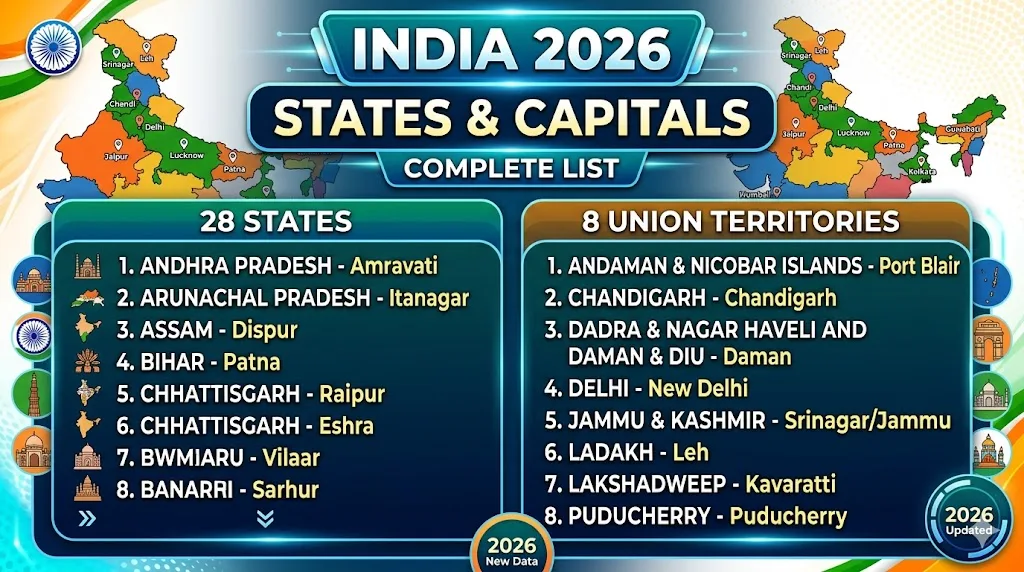
India is the seventh-largest country in the world by area and the most populous, home to over 1.42 billion people. To govern a nation this vast and diverse, India follows a federal structure, dividing the country into states and union territories. As of 2026, India has 28 states and 8 union territories, together forming 36 administrative divisions.
For anyone preparing for competitive exams like SSC, UPSC, Railways, banking, or state PSC examinations, the list of states and capitals is one of the most basic — and most frequently tested — pieces of general knowledge. But simply memorising the list is not enough. Understanding why and when each state was formed gives you a much stronger grip on the topic. In this guide, we cover the complete updated list, the difference between states and union territories, and the key facts examiners love to ask.
How Many States and Union Territories Does India Have in 2026?
As of 2026, India has 28 states and 8 union territories. This number has stayed the same since two major changes took place:
- On 31 October 2019, the former state of Jammu and Kashmir was reorganised into two union territories — Jammu & Kashmir (with a legislature) and Ladakh (without a legislature).
- On 26 January 2020, the two union territories of Daman & Diu and Dadra & Nagar Haveli were merged into a single union territory.
A common mistake students make is recalling the older figure of 29 states. That number is outdated. Since early 2020, the correct answer for any exam is 28 states and 8 union territories.
States and Capitals of India 2026 (Complete List)
Below is the full list of all 28 Indian states with their capitals and the year they were formed.
| State | Capital | Formed |
|---|---|---|
| Andhra Pradesh | Amaravati | 1956 |
| Arunachal Pradesh | Itanagar | 1987 |
| Assam | Dispur | 1950 |
| Bihar | Patna | 1950 |
| Chhattisgarh | Raipur | 2000 |
| Goa | Panaji | 1987 |
| Gujarat | Gandhinagar | 1960 |
| Haryana | Chandigarh | 1966 |
| Himachal Pradesh | Shimla | 1971 |
| Jharkhand | Ranchi | 2000 |
| Karnataka | Bengaluru | 1956 |
| Kerala | Thiruvananthapuram | 1956 |
| Madhya Pradesh | Bhopal | 1956 |
| Maharashtra | Mumbai | 1960 |
| Manipur | Imphal | 1972 |
| Meghalaya | Shillong | 1972 |
| Mizoram | Aizawl | 1987 |
| Nagaland | Kohima | 1963 |
| Odisha | Bhubaneswar | 1950 |
| Punjab | Chandigarh | 1966 |
| Rajasthan | Jaipur | 1950 |
| Sikkim | Gangtok | 1975 |
| Tamil Nadu | Chennai | 1956 |
| Telangana | Hyderabad | 2014 |
| Tripura | Agartala | 1972 |
| Uttar Pradesh | Lucknow | 1950 |
| Uttarakhand | Dehradun (winter) / Gairsain (summer) | 2000 |
| West Bengal | Kolkata | 1950 |
Union Territories of India 2026 and Their Capitals
Union territories are governed directly by the central government through a Lieutenant Governor or Administrator, rather than by an independent state government. Here are all 8 union territories as of 2026:
| Union Territory | Capital |
|---|---|
| Andaman & Nicobar Islands | Port Blair |
| Chandigarh | Chandigarh |
| Dadra & Nagar Haveli and Daman & Diu | Daman |
| Delhi (NCT) | New Delhi |
| Jammu & Kashmir | Srinagar (summer) / Jammu (winter) |
| Ladakh | Leh / Kargil |
| Lakshadweep | Kavaratti |
| Puducherry | Puducherry |
Difference Between a State and a Union Territory
This is a favourite area for exam questions, so it’s worth understanding clearly.
A state has its own elected government, a legislative assembly, and a Chief Minister who heads the administration. States enjoy powers granted directly by the Constitution and operate with a high degree of self-governance.
A union territory, on the other hand, is administered directly by the central government through a Lieutenant Governor or Administrator. Most union territories do not have their own legislature. However, two of them — Delhi and Puducherry — are exceptions, as they have their own elected legislative assemblies and Chief Ministers, giving them partial statehood-like powers.
In short: states govern themselves; union territories are largely governed from the centre.
Interesting Facts About India’s States and Capitals
These are the kinds of facts that frequently appear in the general awareness section of competitive exams:
- Telangana is the youngest state in India, formed on 2 June 2014 after being carved out of Andhra Pradesh.
- Rajasthan is the largest state by area, while Goa is the smallest.
- Uttar Pradesh is the most populous state, while Sikkim has the smallest population.
- Chandigarh is unique — it serves as the shared capital of two states, Punjab and Haryana, while also being a union territory itself.
- Several states follow a dual-capital system for summer and winter legislative sessions, including Himachal Pradesh, Uttarakhand, and Maharashtra.
- The Seven Sister States of Northeast India are Arunachal Pradesh, Assam, Manipur, Meghalaya, Mizoram, Nagaland, and Tripura, with Sikkim often called the lone “brother.”
- New Delhi is the capital of India and is itself part of a union territory — the National Capital Territory of Delhi.
Why States Were Reorganised
India’s current map is not random — it is the result of decades of reorganisation, largely along linguistic lines. After independence, the States Reorganisation Act of 1956, based on the recommendations of the Fazl Ali Commission, redrew state boundaries primarily according to language. Andhra State, formed in 1953, was the first state created on a linguistic basis.
Under Article 3 of the Indian Constitution, Parliament has the power to form new states, alter boundaries, or change the names of existing states. This is why India’s map is sometimes described as a “living document” — it can change as new administrative or political needs arise.
How to Memorise States and Capitals Easily
If you are preparing for an exam, here are a few practical tips that work better than rote memorisation:
- Group by region — Learn the states by zones (North, South, East, West, Northeast). Grouping makes recall far easier than learning a random alphabetical list.
- Use a map — Visual learning sticks. Look at a labelled map of India regularly and trace each state and its capital.
- Link capitals to facts — Associating a capital with a landmark or fact (for example, Shillong as the “Scotland of the East”) helps memory.
- Revise the recent changes — Examiners love testing the 2019–2020 reorganisation, so make sure you remember Ladakh, the J&K split, and the Daman & Diu merger.
Conclusion
As of 2026, India consists of 28 states and 8 union territories — a structure shaped by linguistic reorganisation, the integration of princely states, and the major 2019 reforms in Jammu and Kashmir. For competitive exam aspirants, this topic is unavoidable, appearing in everything from SSC and Railways general awareness to UPSC polity and geography.
Knowing the list is the first step. Understanding the difference between states and union territories, the key facts, and the reasons behind reorganisation is what will help you answer trickier questions with confidence. Bookmark this page and revise it regularly as part of your general knowledge preparation.
Note: Administrative details can change if Parliament passes new reorganisation laws. Always cross-check with official government sources for the latest updates.

Zahid Bhat is an education writer with over 6 years of experience covering government jobs, competitive exams, and scholarships across India. He writes for REFE JOB to help students and aspirants — from Jammu & Kashmir to Tamil Nadu — get accurate, free, and timely information about SSC, IBPS, UPSC, JKSSB, and state recruitment boards. Every post is sourced from official notifications and government portals.