
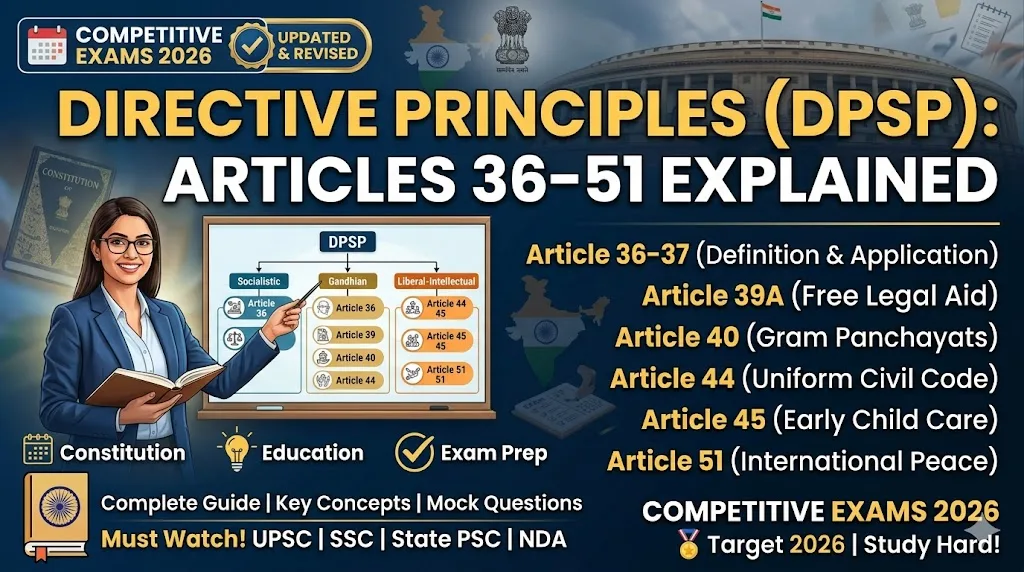
The Directive Principles of State Policy are one of the most frequently tested topics in Indian competitive exams — yet many aspirants lose marks on them because they try to memorize individual articles without understanding the logic behind the whole Part IV of the Constitution.
This guide explains DPSP the right way: what they are, why they exist, how they are classified, which articles are most important for exams, and how they differ from Fundamental Rights. By the end, you will be able to answer any DPSP question in UPSC, SSC CGL, JKSSB, or state PSC exams with confidence.
What Are Directive Principles of State Policy?
Directive Principles of State Policy are guidelines contained in Part IV of the Indian Constitution, Articles 36 to 51. They direct the State — meaning the central government, state governments, and all authorities acting under them — to keep certain social, economic, and political goals in mind while making laws and policies.
The term “directive” is the key word. These principles direct the government toward a certain vision of society. They are not commands that can be enforced in a court of law — but they are fundamental to governance and the Constitution itself declares they shall be kept in mind by the State in all its actions.
Dr. B.R. Ambedkar described DPSP as a “novel feature” of the Indian Constitution. The idea was borrowed from the Irish Constitution of 1937, which itself drew from the Spanish Constitution.
Are DPSP Enforceable in Court?
This is one of the most tested distinctions in competitive exams.
No — DPSP are not justiciable. Article 37 clearly states that while DPSP are fundamental to governance, they shall not be enforceable by any court. A citizen cannot go to court and demand that the government implement a DPSP.
This contrasts with Fundamental Rights (Part III), which are justiciable — meaning a citizen can directly approach the Supreme Court under Article 32 or a High Court under Article 226 if a Fundamental Right is violated.
| Feature | Fundamental Rights | DPSP |
|---|---|---|
| Part of Constitution | Part III | Part IV |
| Enforceable in court | Yes — justiciable | No — non-justiciable |
| Nature | Negative (restrain the State) | Positive (direct the State) |
| Borrowed from | USA, UK, others | Irish Constitution |
| Purpose | Protect individual liberty | Promote social & economic justice |
Classification of DPSP
The Constitution does not classify DPSP into categories — but constitutional scholars and exam preparation guides commonly divide them into three groups for easier understanding:
1. Socialistic Principles
These aim at reducing inequality and promoting social and economic justice.
- Article 38 — State to promote welfare of people; reduce inequalities in income, status, and opportunities
- Article 39 — Equal pay for equal work; right to adequate livelihood; prevent concentration of wealth
- Article 39A — Free legal aid to ensure justice is not denied due to poverty (added by 42nd Amendment)
- Article 41 — Right to work, education, and public assistance in cases of unemployment, old age, sickness
- Article 42 — Just and humane conditions of work and maternity relief
- Article 43 — Living wage and decent standard of life for workers
- Article 43A — Participation of workers in management of industries (added by 42nd Amendment)
- Article 47 — Raise level of nutrition and standard of living; improve public health; prohibit intoxicating drinks
2. Gandhian Principles
These reflect Mahatma Gandhi’s vision of a decentralized, village-based India.
- Article 40 — Organize village panchayats and give them necessary powers
- Article 43 — Promote cottage industries in rural areas
- Article 43B — Promote voluntary formation of cooperative societies (added by 97th Amendment)
- Article 46 — Promote educational and economic interests of SC, ST, and weaker sections
- Article 47 — Prohibition of intoxicating drinks and drugs harmful to health
- Article 48 — Organize agriculture and animal husbandry on modern scientific lines; prohibit slaughter of cows and calves
3. Liberal-Intellectual Principles
These reflect a broader vision of international peace, uniform laws, and environmental protection.
- Article 44 — Uniform Civil Code throughout the territory of India
- Article 45 — Early childhood care and education for children below 6 years (modified by 86th Amendment)
- Article 48A — Protect and improve the environment; safeguard forests and wildlife (added by 42nd Amendment)
- Article 49 — Protect monuments, places, and objects of national importance
- Article 50 — Separate the judiciary from the executive in public services
- Article 51 — Promote international peace and security; maintain just relations between nations
Article-wise Summary: Most Important DPSP for Exams
| Article | Subject | Exam Importance |
|---|---|---|
| 36 | Definition of State (same as Article 12) | Moderate |
| 37 | Application of DPSP — not enforceable | Very High |
| 38 | State to secure social order for welfare | High |
| 39 | Equal pay, adequate livelihood, no concentration of wealth | Very High |
| 39A | Free legal aid | High |
| 40 | Village Panchayats | Very High |
| 41 | Right to work and education | High |
| 42 | Maternity relief | High |
| 43 | Living wage for workers | Moderate |
| 44 | Uniform Civil Code | Very High |
| 45 | Early childhood care | High |
| 46 | Welfare of SC/ST and weaker sections | High |
| 47 | Nutrition, public health, prohibition | Very High |
| 48 | Agriculture, animal husbandry, cow protection | High |
| 48A | Environment protection | Very High |
| 50 | Separation of judiciary from executive | High |
| 51 | International peace | Moderate |
DPSP Added by Constitutional Amendments
Several important DPSP were not in the original Constitution — they were added later. These are frequently asked in exams:
| Article | Added By | Subject |
|---|---|---|
| 39A | 42nd Amendment (1976) | Free legal aid |
| 43A | 42nd Amendment (1976) | Worker participation in management |
| 48A | 42nd Amendment (1976) | Environmental protection |
| 43B | 97th Amendment (2011) | Cooperative societies |
The 42nd Amendment (1976) is the most important amendment for DPSP — it added three new directive principles and also tried to give DPSP precedence over Fundamental Rights (though this was later limited by the Supreme Court).
DPSP vs Fundamental Rights — The Conflict Question
The relationship between DPSP and Fundamental Rights has been one of the most debated constitutional questions in India. The key cases to know:
State of Madras v. Champakam Dorairajan (1951): Supreme Court held that Fundamental Rights prevail over DPSP if there is a conflict. Parliament responded by passing the First Constitutional Amendment.
Golaknath Case (1967): Supreme Court said Parliament cannot amend Fundamental Rights even to implement DPSP.
Kesavananda Bharati Case (1973): Supreme Court established the Basic Structure Doctrine — Parliament can amend Fundamental Rights but cannot destroy the basic structure of the Constitution.
Minerva Mills Case (1980): Supreme Court struck down parts of the 42nd Amendment that tried to give DPSP absolute precedence over Fundamental Rights. The Court held that harmony between Fundamental Rights and DPSP is part of the basic structure.
Exam takeaway: Today, neither DPSP nor Fundamental Rights automatically prevails over the other. Courts try to harmonize both. But if genuine conflict exists, Fundamental Rights generally prevail — except where Parliament has specifically amended the Constitution to protect a law implementing DPSP (under Article 31B and the Ninth Schedule).
DPSP That Have Been Implemented
Many DPSP have been converted into laws and policies over the decades:
- Article 39A → Legal Services Authorities Act, 1987 — free legal aid through DLSA and SLSA
- Article 40 → 73rd Constitutional Amendment (1992) — Panchayati Raj system made constitutional
- Article 44 → Partially — Goa has a Uniform Civil Code; national UCC remains a policy debate
- Article 45 → Right to Education Act, 2009 — free and compulsory education up to age 14
- Article 48A → Environment Protection Act, 1986; Forest Conservation Act, 1980
- Article 47 → Partial prohibition laws in various states
Frequently Asked Questions (DPSP)
Q1: How many articles are there in DPSP? A: DPSP covers Articles 36 to 51 — a total of 16 articles in Part IV of the Constitution.
Q2: From which constitution were DPSP borrowed? A: The concept of DPSP was borrowed from the Irish Constitution of 1937.
Q3: Which amendment added the maximum number of new DPSP? A: The 42nd Constitutional Amendment of 1976 added three new DPSP — Articles 39A, 43A, and 48A.
Q4: What is the difference between DPSP and Fundamental Duties? A: DPSP are directed at the State — they tell the government what to do. Fundamental Duties (Article 51A, Part IVA) are directed at citizens — they tell individuals what responsibilities they have toward the nation.
Q5: Is Uniform Civil Code a Fundamental Right or a DPSP? A: It is a DPSP under Article 44 — not a Fundamental Right. It is a directive to the State to work toward a uniform civil code for all citizens, but it is not enforceable in court.
Q6: Which DPSP is related to environment protection? A: Article 48A — added by the 42nd Amendment in 1976 — directs the State to protect and improve the environment and to safeguard forests and wildlife.
Quick Revision Table for Exam Day
| Classification | Key Articles |
|---|---|
| Socialistic | 38, 39, 39A, 41, 42, 43, 43A, 47 |
| Gandhian | 40, 43, 43B, 46, 47, 48 |
| Liberal-Intellectual | 44, 45, 48A, 49, 50, 51 |
| Added by 42nd Amendment | 39A, 43A, 48A |
| Most exam-important | 37, 39, 40, 44, 47, 48A |
Conclusion
Directive Principles of State Policy represent the socio-economic vision of the Indian Constitution — what the framers wanted India to become, not just what citizens are immediately entitled to. For competitive exam aspirants, mastering DPSP means understanding the classification, knowing the key articles by number and subject, being clear on the DPSP vs Fundamental Rights distinction, and remembering the landmark Supreme Court cases. Use the tables in this guide for your last-week revision and you will not lose a single mark on this topic.

Zahid Bhat is an education writer with over 6 years of experience covering government jobs, competitive exams, and scholarships across India. He writes for REFE JOB to help students and aspirants — from Jammu & Kashmir to Tamil Nadu — get accurate, free, and timely information about SSC, IBPS, UPSC, JKSSB, and state recruitment boards. Every post is sourced from official notifications and government portals.