
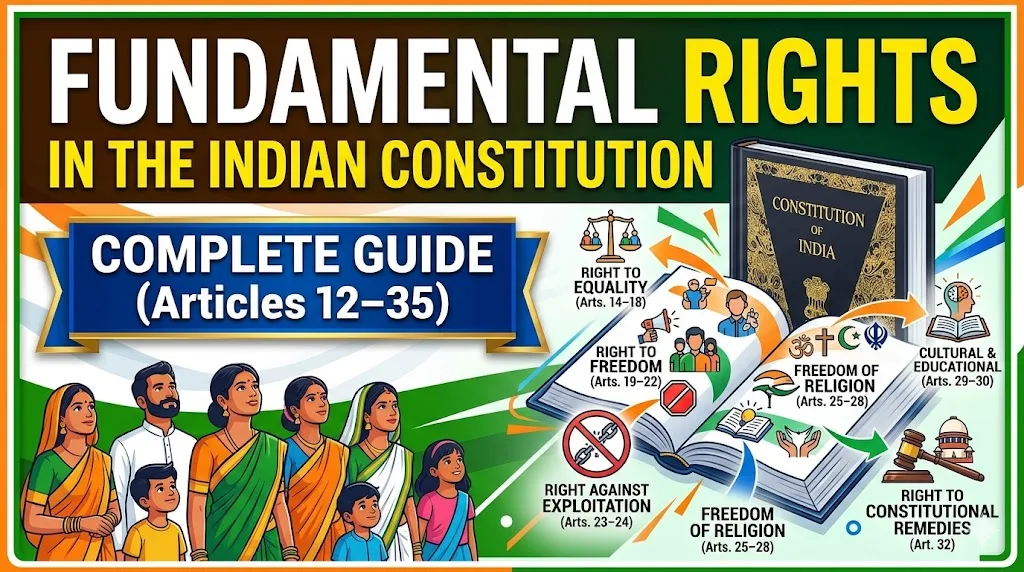
The Fundamental Rights are the basic human rights guaranteed to every citizen by the Indian Constitution. Enshrined in Part III of the Constitution (Articles 12 to 35), these rights protect individuals from the misuse of power by the State and form the very foundation of Indian democracy. Because of their importance, Part III is often called the “Magna Carta of India.”
For students preparing for UPSC, SSC, state PSC, banking, and law entrance exams, Fundamental Rights are one of the most heavily tested topics in the polity section. This guide explains what Fundamental Rights are, the six categories, the articles under each, and the key facts examiners frequently ask.
What Are Fundamental Rights?
Fundamental Rights are the essential freedoms guaranteed to citizens, considered necessary for the development of every individual’s personality and for preserving human dignity. They are called “fundamental” for two reasons: they are written into the Constitution, and they are legally enforceable — meaning a person can approach the courts directly if these rights are violated.
The development of Fundamental Rights in India was heavily inspired by the Bill of Rights of the United States Constitution. These rights protect individual liberty against arbitrary action by the State, and the Indian judiciary acts as their guardian against both executive and legislative violations.
Articles 12 and 13: The Foundation
Before listing the rights, the Constitution defines two key terms:
- Article 12 defines the term “State” for Part III. It includes the Government and Parliament of India, the state governments and legislatures, all local authorities (like municipalities), and other authorities such as statutory and non-statutory bodies. This matters because Fundamental Rights are mainly enforceable against the State.
- Article 13 declares that any law inconsistent with or in violation of Fundamental Rights shall be void. This gives the judiciary the power of judicial review.
Originally Seven, Now Six Rights
A favourite exam point: the original Constitution of 1950 guaranteed seven Fundamental Rights. The seventh was the Right to Property (Article 31). However, the 44th Constitutional Amendment Act of 1978 removed the Right to Property from Part III and made it an ordinary legal right under Article 300A in Part XII of the Constitution. So today, there are six Fundamental Rights.
The Six Fundamental Rights
1. Right to Equality (Articles 14–18)
This is the cornerstone of Indian democracy, ensuring that every person is treated equally regardless of religion, race, caste, sex, or place of birth.
- Article 14: Equality before the law and equal protection of the laws. (“Equality before law” is a negative concept drawn from the British Constitution; “equal protection of laws” is a positive concept drawn from the US Constitution.)
- Article 15: Prohibition of discrimination on grounds of religion, race, caste, sex, or place of birth.
- Article 16: Equality of opportunity in matters of public employment.
- Article 17: Abolition of untouchability.
- Article 18: Abolition of titles.
2. Right to Freedom (Articles 19–22)
This right guarantees various individual freedoms essential in a democracy.
- Article 19 guarantees six freedoms: speech and expression, assembly (peacefully and without arms), association, movement throughout India, residence, and profession. These are subject to reasonable restrictions on grounds such as public order, security, and defamation. Note that the freedom of assembly does not include the right to strike.
- Article 20: Protection in respect of conviction for offences.
- Article 21: Protection of life and personal liberty — one of the most important and widely interpreted articles, now including the right to dignity, education, privacy, and more.
- Article 21A: Right to elementary education (free and compulsory for children aged 6–14).
- Article 22: Protection against arrest and detention in certain cases.
3. Right against Exploitation (Articles 23–24)
This right protects vulnerable people from exploitation.
- Article 23: Prohibition of human trafficking and forced labour (begar).
- Article 24: Prohibition of employment of children below 14 years in factories, mines, and other hazardous work.
4. Right to Freedom of Religion (Articles 25–28)
This right reflects India’s secular character.
- Article 25: Freedom of conscience and free profession, practice, and propagation of religion.
- Article 26: Freedom to manage religious affairs.
- Article 27: Freedom from paying taxes for the promotion of any particular religion.
- Article 28: Freedom from attending religious instruction in certain educational institutions.
5. Cultural and Educational Rights (Articles 29–30)
These rights protect the interests of minorities.
- Article 29: Protection of the interests of minorities — any section of citizens with a distinct language, script, or culture has the right to conserve it.
- Article 30: Right of minorities to establish and administer educational institutions of their choice.
6. Right to Constitutional Remedies (Article 32)
This is what makes all the other rights meaningful. Article 32 gives citizens the right to approach the Supreme Court directly if their Fundamental Rights are violated. Dr. B. R. Ambedkar called Article 32 the “heart and soul of the Constitution.”
Under this right, the Supreme Court (and High Courts under Article 226) can issue five types of writs: Habeas Corpus, Mandamus, Prohibition, Certiorari, and Quo Warranto.
Key Features of Fundamental Rights
- Some rights are available only to citizens (e.g., Articles 15, 16, 19), while others are available to all persons, including foreigners and legal persons like companies (e.g., Articles 14, 21).
- They are justiciable — enforceable in court.
- They are not absolute — the State can impose reasonable restrictions.
- Certain rights can be suspended during a National Emergency under Article 352 (though Article 20 and 21 cannot be suspended).
Fundamental Rights vs. Right to Property
| Aspect | Before 1978 | After 44th Amendment (1978) |
|---|---|---|
| Status | Fundamental Right | Legal Right |
| Article | Article 31 | Article 300A |
| Part | Part III | Part XII |
| Court remedy | Could approach SC under Article 32 | Cannot use Article 32 |
Key Facts to Remember for Exams
- Fundamental Rights are in Part III, Articles 12 to 35.
- Part III is called the “Magna Carta of India.”
- Inspired by the US Bill of Rights.
- Originally seven rights; now six after the 44th Amendment (1978) removed the Right to Property.
- Article 12 defines “State”; Article 13 provides for judicial review.
- Article 32 is the “heart and soul of the Constitution” (Ambedkar).
- Five writs: Habeas Corpus, Mandamus, Prohibition, Certiorari, Quo Warranto.
Conclusion
The Fundamental Rights enshrined in Articles 12 to 35 form the backbone of India’s democratic system. They guarantee equality, freedom, protection from exploitation, religious liberty, cultural and educational rights, and — crucially — the right to seek justice through the courts. By limiting the power of the State and protecting individual dignity, these rights ensure that India functions as a true democracy rather than an authoritarian state.
For competitive exam aspirants, mastering the six categories, the articles under each, the originally-seven-now-six point, and the role of Article 32 will help you confidently tackle the many questions that come from this part of the Constitution.
Note: Constitutional interpretations evolve through court judgments. Always refer to the official text of the Constitution and recent Supreme Court rulings for the most current understanding.

Zahid Bhat is an education writer with over 6 years of experience covering government jobs, competitive exams, and scholarships across India. He writes for REFE JOB to help students and aspirants — from Jammu & Kashmir to Tamil Nadu — get accurate, free, and timely information about SSC, IBPS, UPSC, JKSSB, and state recruitment boards. Every post is sourced from official notifications and government portals.