
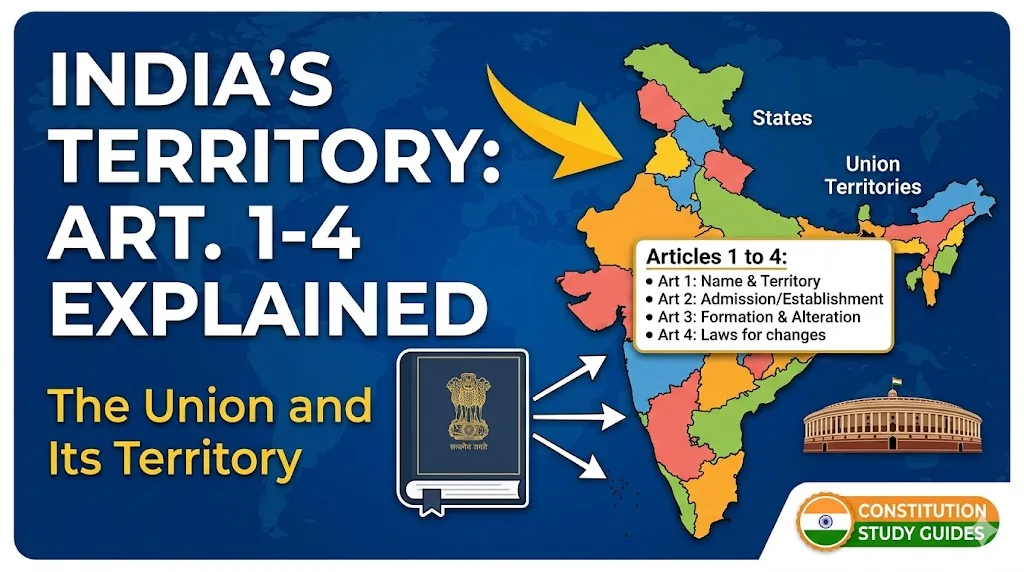
Part I of the Indian Constitution, titled “The Union and its Territory,” is made up of Articles 1 to 4. Though it sits at the very beginning of the Constitution and contains only four articles, this part lays the entire foundation for how India is defined as a country, how its territory is organised, and how Parliament can create, merge, or reorganise states. For students preparing for UPSC, SSC, state PSC, and other competitive exams, Articles 1 to 4 are among the most frequently tested topics in the polity section.
In this guide, we break down each of these four articles in simple language, explain the important constitutional concepts behind them, and highlight the key facts examiners love to ask.
What Does Part I of the Constitution Deal With?
Part I covers the establishment of India as a Union, the definition of its territory, and the legal mechanism for changing the map of the country — whether that means admitting a new state, creating one, merging two, or renaming an existing state. In practice, these articles were invoked when states like Jharkhand, Chhattisgarh, and Telangana were created, and when West Bengal was renamed.
Article 1: Name and Territory of the Union
Article 1 defines two things — the name of the country and the nature of its polity.
- Article 1(1): “India, that is Bharat, shall be a Union of States.” Both names, India and Bharat, were adopted after debate in the Constituent Assembly.
- Article 1(2): The states and their territories shall be as specified in the First Schedule of the Constitution.
- Article 1(3): The territory of India comprises (a) the territories of the states, (b) the union territories specified in the First Schedule, and (c) such other territories as may be acquired by India in the future.
Why “Union of States” and Not “Federation”?
This is a classic exam question. Dr. B. R. Ambedkar explained that the term “Union of States” was deliberately chosen over “Federation of States” for two reasons:
- The Indian Union is not the result of an agreement among the states (unlike the American federation).
- The states have no right to secede from the Union.
In other words, India is described as a “Union” because it is indestructible. The country may be divided into different states for the convenience of administration, but no state has the right to break away. India remains one integral whole.
Difference Between “Union of India” and “Territory of India”
Students often confuse these two terms, but the distinction is important and frequently tested:
- Union of India includes only the states — the members of the federal system that share power with the central government.
- Territory of India is wider. It includes the states, the union territories, and any other territories India may acquire in the future.
So every state is part of both the Union and the territory of India, but union territories are part of the territory of India without being part of the Union of States in the federal power-sharing sense.
Article 2: Admission or Establishment of New States
Article 2 empowers Parliament to admit new states into the Union or establish new states on terms and conditions it considers appropriate.
The key point here is that Article 2 deals with states that are not already part of India — for example, a territory acquired from outside. It gives Parliament wide discretion over how such territories are brought in. This article can even affect India’s international boundaries.
Article 3: Formation of New States and Alteration of Existing States
Article 3 is the most practically important of the four. It gives Parliament the power to:
- Form a new state by separating territory from an existing state, or by uniting two or more states.
- Increase or decrease the area of any state.
- Alter the boundaries of any state.
- Change the name of any state.
Important Conditions Under Article 3
- A bill for these changes can be introduced in Parliament only on the recommendation of the President.
- Before recommending the bill, the President must refer it to the legislature of the affected state for its views — within a specified time limit.
- However, Parliament is not bound by the state legislature’s opinion. It can accept, reject, or modify the views. This means a new state can be created even without the affected state’s consent.
This is why states like Telangana could be carved out of Andhra Pradesh through parliamentary action.
Article 4: Laws Made Under Articles 2 and 3
Article 4 clarifies an important technical point. It declares that laws made under Article 2 (admission/establishment of new states) and Article 3 (formation and alteration of states) are not considered constitutional amendments under Article 368.
This means such laws can be passed by a simple majority through the ordinary legislative process, rather than the special majority required for constitutional amendments. Article 4 also allows for the necessary consequential changes to the First Schedule (list of states and territories) and the Fourth Schedule (allocation of Rajya Sabha seats).
The Berubari Union Case
A landmark case linked to this part is the Berubari Union Case (1960). The Supreme Court held that the power under Article 3 does not include the power to cede Indian territory to a foreign country. Ceding territory to another nation requires a constitutional amendment under Article 368, not just an ordinary law. This established an important limit on Parliament’s territorial powers.
Key Facts to Remember for Exams
- Part I of the Constitution = “The Union and its Territory” = Articles 1 to 4.
- Article 1 calls India a “Union of States.”
- The term “Union” reflects that India is indestructible and states cannot secede.
- The First Schedule lists the states and union territories.
- Article 3 lets Parliament reorganise states without their consent, but only on the President’s recommendation and after referring the bill to the state legislature.
- Article 4 allows these changes by simple majority (not a constitutional amendment).
- The Berubari case held that ceding territory to a foreign state requires a constitutional amendment.
Conclusion
Articles 1 to 4 may be short, but they form the constitutional backbone of India’s territorial structure. They define India as an indestructible Union of States, describe what counts as the territory of India, and give Parliament the authority to reshape the country’s internal map as administrative and political needs evolve. For any competitive exam aspirant, mastering these four articles — along with the Ambedkar reasoning, the Article 3 procedure, and the Berubari case — is essential, because questions from this part appear again and again.
Frequently Asked Questions
Q1. How many states does India have in 2026? India has 28 states and 8 union territories as of 2026. The number changed from 29 states in 2019 when Jammu & Kashmir was reorganised into two separate union territories.
Q2. Which is the newest state in India? Telangana is the newest state, formed on 2 June 2014 when it was carved out of the former Andhra Pradesh.
Q3. Which Indian state has two capitals? Several states have dual capitals. Uttarakhand has Dehradun (winter) and Gairsain (summer). Himachal Pradesh has Shimla (summer) and Dharamsala (winter). Jammu & Kashmir, now a union territory, has Srinagar (summer) and Jammu (winter).
Q4. Which is the largest and smallest state in India by area? Rajasthan is the largest state by area at approximately 3.42 lakh sq km. Goa is the smallest state by area at approximately 3,702 sq km.
Q5. Is this topic asked in SSC, UPSC, and state PSC exams? Yes — states, capitals, and union territories are asked in almost every competitive exam in India including SSC CGL, SSC CHSL, UPSC Prelims, IBPS, Railways, and all state PSC exams including JKSSB and JKPSC.
Bookmark this page and revise it alongside your study of the First Schedule and the reorganisation of Indian states for a complete understanding of India’s federal framework.

Zahid Bhat is an education writer with over 6 years of experience covering government jobs, competitive exams, and scholarships across India. He writes for REFE JOB to help students and aspirants — from Jammu & Kashmir to Tamil Nadu — get accurate, free, and timely information about SSC, IBPS, UPSC, JKSSB, and state recruitment boards. Every post is sourced from official notifications and government portals.