
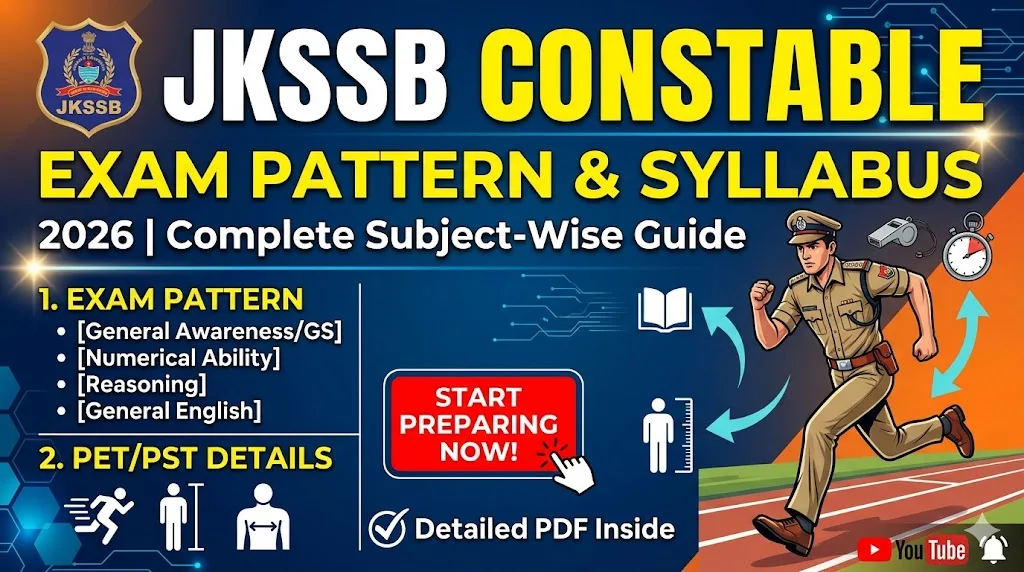
If you are one of the thousands of young aspirants in Jammu & Kashmir dreaming of a career in uniform, the JKSSB Constable Recruitment 2026 is your biggest opportunity of the year. The Jammu and Kashmir Services Selection Board (JKSSB) has notified 1,815 vacancies for the post of Constable (Executive Police) under the Home Department — and the competition, as always in J&K government recruitment, is going to be fierce.
With over 5 lakh candidates having applied in previous recruitment cycles and the competition ratio potentially crossing 250 to 300 candidates per seat, your preparation strategy will determine whether you make it or not. And the very first step of a winning strategy is understanding the exam pattern and syllabus inside-out.
This comprehensive guide breaks down the complete JKSSB Constable Exam Pattern and Syllabus 2026 — subject by subject, topic by topic — along with physical test requirements, selection stages, salary details, and proven preparation tips. Read it carefully, bookmark it, and use it as your roadmap to success.
JKSSB Constable Recruitment 2026 — Quick Overview
Before diving into the syllabus, here is a snapshot of the key recruitment details:
| Parameter | Details |
|---|---|
| Recruiting Body | Jammu & Kashmir Services Selection Board (JKSSB) |
| Post Name | Constable (Executive Police) |
| Department | Home Department, J&K |
| Total Vacancies | 1,815 Posts |
| Notification No. | Advertisement No. 12 of 2025 |
| Educational Qualification | Matriculation (10th Pass) |
| Age Limit | 18 – 28 Years |
| Domicile Requirement | J&K Domicile Certificate Mandatory |
| Application Mode | Online at jkssb.nic.in |
| Salary | Pay Level 2 (₹19,900 – ₹63,200) |
| Exam Mode | Objective Type (OMR/CBT) |
| Official Website | jkssb.nic.in |
JKSSB Constable Selection Process 2026 — All Stages
Before understanding the syllabus, every aspirant must clearly know what stages they will face. The JKSSB Constable 2026 selection process is conducted in four stages:
Stage 1 — Written Examination: This is the most critical stage. It is an objective-type examination with 100 multiple-choice questions for 100 marks. The written exam is the primary filter, and the final merit list is prepared solely on the basis of written exam marks. PST and PET are qualifying in nature only.
Stage 2 — Physical Standard Test (PST): Based on the written exam merit, candidates equal to 6 times the total number of vacancies in each category are shortlisted for PST. This test measures physical parameters including height and chest measurements. It is qualifying in nature.
Stage 3 — Physical Endurance Test (PET): Only candidates who qualify PST are called for PET. It assesses physical fitness through activities like race, push-ups, and shot put. This stage is also qualifying.
Stage 4 — Medical Examination & Document Verification: Candidates who clear all physical tests undergo a medical examination followed by document verification of educational certificates, domicile, category certificates, and other relevant documents.
Critical Point: Since PST and PET are only qualifying stages, your written exam score is what decides your rank and final selection. Focus maximum preparation effort on the written test.
JKSSB Constable Exam Pattern 2026 — Detailed Breakdown
The JKSSB Constable Written Examination 2026 follows a well-defined pattern. Here are all the key details:
| Feature | Details |
|---|---|
| Exam Mode | Objective Type — Multiple Choice Questions |
| Total Questions | 100 |
| Total Marks | 100 |
| Duration | 2 Hours (120 Minutes) |
| Marks per Correct Answer | +1 Mark |
| Negative Marking | −0.25 Mark per Wrong Answer |
| Medium of Exam | English |
| Question Type | MCQ (4 options per question) |
Subject-Wise Marks Distribution
The written exam covers the following subjects (for Constable Executive posts):
| Subject | Approx. Questions |
|---|---|
| General English | 15–20 |
| General Knowledge & Current Affairs (India) | 20–25 |
| General Knowledge with Special Reference to J&K | 20–25 |
| Numerical & Reasoning Ability | 20–25 |
| Basic Concepts of Computers | 10–15 |
| Total | 100 |
For Constable Telecommunication and Constable Photographer posts, an additional section on Technical Subjects (Telecom / Photography) replaces or supplements some general questions.
Note on Negative Marking: With 0.25 marks deducted for every wrong answer, attempting 80 questions correctly is better than blindly attempting all 100 and getting 30 wrong. Practice smart, selective answering.
JKSSB Constable Syllabus 2026 — Subject-Wise Detailed Topics
Here is the complete, topic-by-topic syllabus for each subject in the JKSSB Constable Written Examination 2026:
1. General English
This section tests your command over the English language — grammar, vocabulary, comprehension, and correct usage. Topics include:
Grammar & Usage:
- Parts of Speech (Nouns, Pronouns, Verbs, Adjectives, Adverbs, Prepositions, Conjunctions)
- Tenses — Present, Past, Future (Simple, Continuous, Perfect)
- Active and Passive Voice
- Direct and Indirect Speech (Narration)
- Articles (A, An, The) and their correct usage
- Degrees of Comparison
- Subject-Verb Agreement
Vocabulary:
- Synonyms and Antonyms
- One-word Substitution
- Idioms and Phrases
- Spelling Correction
- Word Meaning in Context
Reading & Comprehension:
- Reading Comprehension passages
- Fill in the Blanks
- Sentence Correction and Rearrangement
- Error Spotting
Writing Skills:
- Sentence Completion
- Cloze Test (Fill in the blanks in a passage)
2. General Knowledge & Current Affairs (India)
This section covers broad awareness of India’s history, geography, polity, economy, science, and current events. Topics include:
Indian History & Freedom Struggle:
- Important dates and events in Indian History
- Major movements of the Freedom Struggle — Non-Cooperation, Civil Disobedience, Quit India Movement
- Key leaders and their contributions — Mahatma Gandhi, Nehru, Subhas Chandra Bose, Bhagat Singh, and others
- Post-Independence history — Formation of States, major milestones
Indian Polity & Constitution:
- Preamble, Fundamental Rights, Fundamental Duties, Directive Principles
- Union Executive — President, Vice President, Prime Minister, Cabinet
- Parliament — Lok Sabha and Rajya Sabha
- Judiciary — Supreme Court and High Courts
- Local Self-Government — Panchayati Raj
- Constitutional Amendments — Important ones
Indian Geography:
- Physical features — Mountains, rivers, plains, plateaus, coasts
- Climate, soils, natural vegetation
- Major rivers and their tributaries
- Minerals, industries, and their locations
- National Parks and Wildlife Sanctuaries
Indian Economy:
- Five Year Plans and their objectives
- Budget basics — Revenue, Expenditure, Deficit
- RBI and monetary policy basics
- Agriculture, industry, and services sectors
- Government flagship schemes — PM Awas Yojana, Jan Dhan Yojana, etc.
Science & Technology:
- Basic Physics — Laws of Motion, Electricity, Light
- Basic Chemistry — Elements, Compounds, Chemical Reactions
- Basic Biology — Human body systems, diseases
- Latest developments in Science and Technology
- Space missions — ISRO achievements
- Defence technology
Current Affairs:
- National and International events of the past 12 months
- Awards — Bharat Ratna, Padma Awards, Nobel Prize
- Sports events — Olympics, Cricket, Hockey
- Appointments — Governors, CJI, Army Chiefs, Ambassadors
- National schemes and policies launched recently
3. General Knowledge with Special Reference to J&K
This section is unique to JKSSB exams and carries high weightage. It tests your in-depth knowledge of Jammu & Kashmir specifically. Topics include:
History of J&K:
- Ancient history of the region — Kingdoms and dynasties
- Medieval history — Mughal, Afghan, Sikh, and Dogra rule
- Accession of J&K to India — 1947 events
- History of Jammu, Kashmir, and Ladakh regions
- Important historical personalities of J&K
Geography of J&K:
- Physical geography — Pir Panjal, Zanskar, Shivalik ranges
- Major rivers — Jhelum, Chenab, Ravi, Tawi, Indus
- Important lakes — Dal Lake, Wular Lake, Mansar Lake
- Districts of J&K — both Jammu and Kashmir divisions
- Union Territory status — reorganization of J&K in 2019
- J&K and Ladakh as Union Territories
Culture, Art & Festivals:
- Folk arts and crafts — Pashmina, Khatamband, Carpet weaving
- Classical arts — Dogri, Kashmiri, Gojri, Pahari traditions
- Important festivals — Baisakhi, Eid, Diwali, Herath, Lohri
- Famous Sufi shrines and temples of J&K
- Traditional cuisine of J&K
Administration & Governance:
- Administrative setup of J&K UT — Lieutenant Governor, Council of Ministers
- Districts and Tehsils
- Major government departments and their functions
- JKSSB, JKPSC, and other recruitment/exam bodies
- J&K Police — organizational structure
Economy of J&K:
- Agriculture — major crops, horticulture
- Tourism — major destinations and their importance
- Industries — handicrafts, sports goods, hydropower
- Important dams and hydroelectric projects
Current Affairs of J&K:
- Recent government decisions and schemes for J&K
- Important appointments in J&K administration
- J&K-specific policies and development projects
4. Numerical & Reasoning Ability
This section tests your quantitative aptitude and logical thinking. Topics include:
Numerical Ability (Mathematics):
- Number System — Natural, Whole, Integers, Fractions, Decimals
- BODMAS and simplification
- LCM and HCF
- Percentage — calculation and application
- Profit and Loss
- Simple Interest and Compound Interest
- Ratio and Proportion
- Time and Work
- Time, Speed and Distance
- Average
- Area, Perimeter, and Volume — basic geometry
- Data Interpretation — Tables, Bar Graphs, Pie Charts
- Number Series — finding missing numbers
Reasoning Ability:
- Analogy (Word-based and Number-based)
- Classification (Odd One Out)
- Series Completion (Number, Letter, Mixed)
- Coding and Decoding
- Blood Relations
- Direction and Distance
- Ranking and Arrangement
- Seating Arrangement
- Syllogism
- Venn Diagrams
- Statement and Conclusions
- Mirror and Water Images
- Embedded Figures and Paper Folding
5. Basic Concepts of Computers
This section covers fundamental computer knowledge relevant to modern policing and administrative work. Topics include:
- History and generations of computers
- Types of computers — Desktop, Laptop, Tablet, Mainframe, Supercomputer
- Hardware components — CPU, RAM, ROM, Hard Disk, Input/Output devices
- Software — System Software, Application Software, Open Source Software
- Operating Systems — Windows, Linux basics
- Microsoft Office Suite — MS Word, MS Excel, MS PowerPoint basic operations
- Internet basics — WWW, Browser, Search Engine, Email, URL, HTTP/HTTPS
- Networking fundamentals — LAN, WAN, MAN, IP Address, Router
- Cyber Security basics — Viruses, Malware, Firewall, Password protection
- Digital India — Government digital initiatives, e-Governance
- Social media awareness — Facebook, Twitter, WhatsApp usage in policing context
- Basic troubleshooting — common computer problems and solutions
6. Technical Subjects (For Constable Telecommunication & Constable Photographer Only)
For Constable Telecommunication:
- Basics of communication systems — analog and digital
- Types of signals and modulation (AM, FM, PM)
- Networking and data communication
- Radio communication systems used in police
- Satellite communication basics
- Mobile communication — GSM, CDMA
- Telecom equipment maintenance basics
For Constable Photographer:
- Types of cameras — SLR, DSLR, Digital, Video, Pinhole
- Camera formats — Large format, Medium format, Small format
- Principles of photography — aperture, shutter speed, ISO
- Lighting techniques — natural and artificial
- Image composition and framing
- Photo processing — dark room and digital processing
- Forensic photography — crime scene documentation
- Video recording and editing basics
Physical Standard Test (PST) — Requirements
Candidates shortlisted from the written exam (6x the vacancy count per category) must appear for PST. The qualifying physical standards are:
| Category | Height | Chest (Unexpanded) | Chest (Expanded) |
|---|---|---|---|
| Male (General) | 5 ft 6 in (167.5 cm) | 32 inches | 33.5 inches |
| Female (General) | 5 ft 2 in (157.5 cm) | Not Applicable | Not Applicable |
| Gorkha / Bot Tribe (Male) | 5 ft 4 in (relaxation of 2 inches) | 32 inches | 33.5 inches |
Candidates who do not meet the prescribed physical standards during PST are disqualified and not allowed to proceed to PET.
Physical Endurance Test (PET) — Activities
Candidates who qualify PST are called for PET, which measures physical fitness and endurance. Activities typically include:
| Activity | Male Standard | Female Standard |
|---|---|---|
| Race / Running | As per official notification | Shorter distance prescribed |
| Push-Ups | Prescribed count | Not usually required |
| Shot Put | Best of 3 attempts measured | Lighter weight used |
PET is qualifying in nature only — it does not add to the final merit. However, failing PET means disqualification from the recruitment.
Salary & Benefits for JKSSB Constable 2026
Selected candidates will receive a handsome government salary along with various allowances:
| Component | Details |
|---|---|
| Pay Scale | Level 2 of Pay Matrix |
| Basic Pay Range | ₹19,900 – ₹63,200 |
| Dearness Allowance (DA) | As per government revisions |
| House Rent Allowance (HRA) | As per city classification |
| Transport Allowance (TA) | As applicable |
| Medical Benefits | Government health schemes |
The in-hand monthly salary, including all allowances, is estimated to be in the range of ₹25,000 to ₹35,000 for a newly appointed constable, with regular increments and pay revisions over time. Police constables also enjoy job security, pension benefits, housing facilities, and other government perks.
Subject-Wise Preparation Strategy for JKSSB Constable 2026
Cracking the JKSSB Constable written exam requires a smart, structured preparation plan. Here is a subject-by-subject strategy:
General English: English is often where candidates from J&K lose marks. Focus on grammar rules — especially tenses, active-passive voice, and error spotting. Read one English newspaper daily and practice fill-in-the-blank and comprehension passages. Dedicate at least 30 minutes daily to this subject.
General Knowledge (India): This is a vast subject, but the questions are mostly factual and predictable. Use standard GK books like Lucent’s General Knowledge. Focus on Indian Polity, Modern History, and Geography. For current affairs, read a monthly GK capsule and follow government scheme announcements.
J&K General Knowledge: This is your home turf and a high-scoring section for J&K aspirants. Make detailed notes on J&K history, districts, rivers, culture, and recent administration changes. Know every district, its headquarters, and key facts. Be up to date on J&K-specific government schemes and appointments. This section separates local talent from the crowd.
Numerical & Reasoning Ability: Start with the basics — percentage, ratio, profit-loss, and work-time. Practice at least 25–30 questions daily. For reasoning, focus on series, coding-decoding, and direction problems as they appear frequently. Take timed practice tests to improve speed.
Computer Basics: This section is the easiest to score in if you prepare a small topic list and revise it thoroughly. Cover MS Office operations, internet terminology, types of hardware/software, networking basics, and cyber safety. 10–15 days of focused revision is enough.
Mock Tests Are Non-Negotiable: Attempt at least 2 full mock tests per week in the last month of preparation. Timed mock tests simulate exam pressure and expose weak areas. Analyse every mistake and revise the relevant topic.
Important Links for JKSSB Constable 2026
| Resource | Link |
|---|---|
| Official JKSSB Website | jkssb.nic.in |
| Online Application Portal | jkssb.nic.in |
| Official Notification PDF | Available at jkssb.nic.in |
| Download Syllabus PDF | Available at jkssb.nic.in |
Frequently Asked Questions (FAQs)
Q1. How many questions are there in the JKSSB Constable Written Exam? The written exam consists of 100 objective-type multiple-choice questions for 100 marks, to be completed in 2 hours.
Q2. Is there negative marking in the JKSSB Constable exam? Yes. A deduction of 0.25 marks (one-fourth mark) is made for every incorrect answer. Unanswered questions carry no penalty.
Q3. What is the minimum educational qualification required? Candidates must have passed Matriculation (Class 10th) from a recognized Board.
Q4. Is domicile of J&K mandatory? Yes. Candidates must hold a valid J&K Domicile Certificate issued by the Competent Authority on or before the prescribed cutoff date.
Q5. Are PST and PET part of the merit calculation? No. Both PST and PET are qualifying in nature only. The final merit and selection are based exclusively on the written examination marks.
Q6. What is the salary of a JKSSB Constable? The pay scale is Level 2 of the Pay Matrix — ₹19,900 to ₹63,200, plus DA, HRA, TA, and other allowances.
Q7. How many candidates are shortlisted for PST? Candidates equal to 6 times the total vacancies in each category are shortlisted for PST based on written exam merit.
Q8. Can candidates from outside J&K apply? No. J&K domicile is a mandatory requirement for all posts under JKSSB Constable Recruitment 2026.
Final Takeaway — Your Constable Badge is One Exam Away
The JKSSB Constable 2026 exam is tough, competitive, and transformational. Passing it means a secure government job, a respected uniform, and a lifelong career serving Jammu & Kashmir. The syllabus is well-defined and manageable if you approach it with consistency and discipline.
Start your preparation today — master the J&K GK section as it is your biggest differentiator, stay consistent with daily practice in Maths and Reasoning, and keep yourself updated on current affairs. Back it up with strong physical preparation for PST and PET.
Download the official JKSSB Constable Syllabus 2026 PDF from jkssb.nic.in, make your study schedule, and give it everything you have. The uniform is waiting.
Disclaimer: This article is compiled from official JKSSB sources and publicly available recruitment data for informational purposes. Candidates are advised to verify all details from the official JKSSB notification PDF at jkssb.nic.in before making any decisions regarding their application.

Zahid Bhat is an education writer with over 6 years of experience covering government jobs, competitive exams, and scholarships across India. He writes for REFE JOB to help students and aspirants — from Jammu & Kashmir to Tamil Nadu — get accurate, free, and timely information about SSC, IBPS, UPSC, JKSSB, and state recruitment boards. Every post is sourced from official notifications and government portals.