
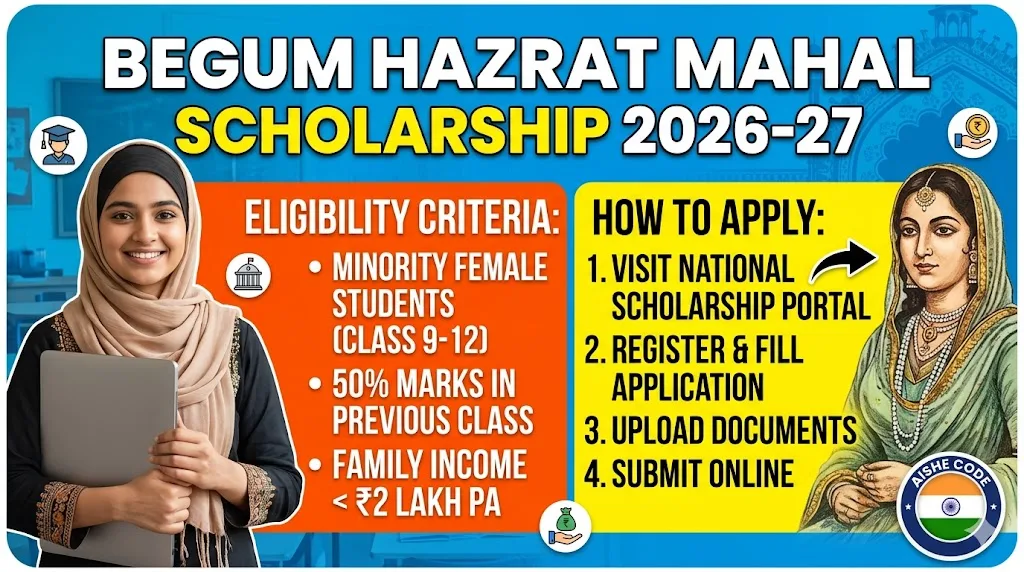
For millions of girls across India, Class 9 is both a beginning and a crossroads. It is where secondary education begins to matter — and where, for families with limited income, the cost of continuing often becomes a quiet crisis. Books, fees, uniforms, transport, and sometimes hostel charges: these are not abstract numbers. They are the reason many girls from minority communities leave school before they ever reach Class 12.
The Begum Hazrat Mahal National Scholarship 2026-27 is the Government of India’s focused response to this reality. Named after the courageous queen of Awadh who stood against colonial rule, this scholarship honours her legacy by standing for something equally important — the right of every girl to complete her education, regardless of her family’s financial position.
If you are a girl student from a minority community, studying in Class 9, 10, 11, or 12, and your family’s annual income does not exceed ₹2 lakh, this scholarship could provide meaningful financial support this academic year. This guide explains everything you need to know — what the scheme is, what it pays, who qualifies, what documents are needed, and exactly how to apply.
Scheme Overview at a Glance
| Detail | Information |
|---|---|
| Scholarship Name | Begum Hazrat Mahal National Scholarship |
| Previously Known As | Maulana Azad Scholarship for Girls |
| Implementing Body | Maulana Azad Education Foundation (MAEF) |
| Funded By | Ministry of Minority Affairs, Government of India |
| Target Beneficiaries | Minority girl students in Classes 9 to 12 |
| Scholarship Amount | ₹5,000 (Class 9 & 10) / ₹6,000 (Class 11 & 12) |
| Family Income Limit | Up to ₹2 lakh per annum |
| Application Portal | scholarships.gov.in (NSP) |
| Payment Mode | Direct Benefit Transfer (DBT) |
| Academic Year | 2026-27 |
What Is the Begum Hazrat Mahal National Scholarship?
The Begum Hazrat Mahal National Scholarship (BHMNS) is a national-level scholarship programme introduced by the Maulana Azad Education Foundation (MAEF) in the academic year 2003-04. It was originally called the Maulana Azad Scholarship for Girls and was renamed to honour Begum Hazrat Mahal, a symbol of courage and women’s resilience in Indian history.
The scheme is funded by the Ministry of Minority Affairs and is entirely implemented through the National Scholarship Portal (NSP). Since its inception, the scholarship has supported nearly six lakh minority girl students across the country, disbursing over ₹504 crore in total financial assistance — making it one of the most impactful education schemes specifically designed for minority girls in India.
The core purpose of the scheme is straightforward: to identify girl students from financially weaker minority households who are at risk of dropping out of school, and give them the financial support needed to continue studying. The scholarship amount can be used towards tuition and school fees, purchase of textbooks and syllabus materials, stationery and equipment required for the course, and boarding or lodging charges where applicable.
Scholarship Amount for 2026-27
The scholarship amount under BHMNS is fixed based on the class the student is currently studying in:
| Class | Annual Scholarship Amount |
|---|---|
| Class 9 | ₹5,000 |
| Class 10 | ₹5,000 |
| Class 11 | ₹6,000 |
| Class 12 | ₹6,000 |
The full amount is disbursed in a single annual payment directly to the student’s Aadhaar-linked bank account through the Direct Benefit Transfer (DBT) mechanism. There are no instalments — once selected and verified, the scholarship amount is credited in one transfer.
There is no additional component for hostel or transport under this scheme beyond the flat annual amount. However, the scholarship guidelines specifically permit the amount to be used for boarding and lodging charges where the student resides away from home for studies.
Who Can Apply — Eligibility Criteria
Every condition below must be met. Missing even one will result in the application being rejected during verification.
1. Gender
This scholarship is exclusively for girl students. Boys are not eligible under this scheme.
2. Minority Community
The applicant must belong to one of the six notified national minority communities:
- Muslim
- Christian
- Sikh
- Buddhist
- Jain
- Parsi (Zoroastrian)
A valid minority community certificate or self-declaration as applicable in your state is required as proof.
3. Class of Study
The student must currently be enrolled in Class 9, 10, 11, or 12 in a recognised school or college. The scholarship does not apply to students below Class 9 or those pursuing undergraduate and higher education courses.
4. Minimum Marks in Previous Examination
The student must have secured at least 50% marks in the previous annual examination. For example:
- A student applying for Class 10 must have scored 50% or more in Class 9 finals.
- A student applying for Class 11 must have scored 50% or more in Class 10 board exams.
There is no exemption to this academic criteria. Students with less than 50% in the qualifying examination are not eligible.
5. Annual Family Income
The total annual family income from all sources — salary, agriculture, business, pension, rent, or any other — must not exceed ₹2 lakh per year. This is a firm ceiling. A valid income certificate from a competent state government authority is mandatory.
6. No Other Government Scholarship
A student who is already receiving a scholarship from any other central or state government scheme during the same academic year is not eligible to apply for BHMNS simultaneously. Only one government scholarship can be availed at a time.
7. Family Limit
The scholarship is not awarded to more than two students from the same family. If two sisters are already receiving this scholarship, a third sibling will not be eligible.
8. No Scholarship for Studies Abroad
The scholarship applies only to students studying in India. It will not be awarded for any course pursued outside the country.
How Are Students Selected?
Selection under the Begum Hazrat Mahal National Scholarship is not random — it follows a structured, merit-cum-means based process.
Step 1 — Eligibility Filtering: Applications are first screened to confirm all eligibility conditions are met — community, class, income, and marks.
Step 2 — State/UT Quota Allocation: A fixed number of scholarship slots are allocated to each State and Union Territory based on the minority population in that state, as per the 2011 Census. This ensures geographic distribution of the scholarship. If a state does not receive sufficient eligible applications, its remaining quota is redistributed to other states from the same community.
Step 3 — Merit-cum-Means Ranking: Within each state’s quota, students are ranked based on their marks in the previous examination. Students with the lowest income are given preference when marks are equal or comparable.
Step 4 — Verification and Approval: Documents are verified at the institutional and MAEF level before final selection. The list of selected students is published on the MAEF website after verification is complete.
This means that simply being eligible does not guarantee selection — your rank within your state’s quota matters. Applying early and ensuring accurate documentation significantly improves your chances.
Documents You Will Need
Prepare all documents in scanned digital form before beginning the online application. Each file must be in JPG or PDF format and within the portal’s file size limit (typically 200 KB per document).
- Minority Community Certificate — issued by a competent state authority, or community-specific declaration as applicable
- Income Certificate — annual family income from all sources, issued by Tehsildar or equivalent authority; must not be older than one year
- Previous Class Marksheet — showing at least 50% marks in the qualifying examination
- Current Year Admission Proof — school fee receipt, admission letter, or bonafide certificate confirming enrolment in Class 9/10/11/12
- Aadhaar Card — mandatory for identity verification and DBT payment
- Bank Account Passbook (First Page) — account must be in the student’s own name and linked with Aadhaar; joint or parent accounts will cause payment failure
- Passport-size Photograph — recent, clear, light background
- Self-Declaration / Affidavit — confirming that no other central or state government scholarship is being received in the same academic year
Keep all originals accessible during the application in case your school or district authorities require physical verification.
How to Apply Online — Step-by-Step Process
The Begum Hazrat Mahal National Scholarship is applied for exclusively through the National Scholarship Portal at scholarships.gov.in. No offline applications are accepted, and there is no application fee whatsoever.
Step 1: Visit the Official NSP Portal
Go to https://scholarships.gov.in — the only official platform. Do not use third-party websites, mobile apps, or agents who claim to assist with the application.
Step 2: Register as a New Applicant
- Click on “New Registration” on the NSP homepage.
- Read the registration guidelines carefully and click “Continue.”
- Fill in the Student Registration Form: name as on Aadhaar, date of birth, mobile number, email address, bank details, and Aadhaar number.
- Verify your mobile number with the OTP sent to it.
- Set a password and save your Application ID — this is your login credential for all future access.
Step 3: Log In to Your Dashboard
Use your Application ID and password to log in. Your student dashboard will display all scholarship schemes you are eligible for based on the details entered.
Step 4: Select the Correct Scholarship
From the list of available scholarships, select “Begum Hazrat Mahal National Scholarship” under the Maulana Azad Education Foundation / Ministry of Minority Affairs. Confirm you are choosing the correct scheme before proceeding.
Step 5: Fill the Application Form
The application form has multiple sections — fill each one with precision:
- Personal Details — name, date of birth, gender, Aadhaar, community/minority category
- Contact Details — address, district, state, PIN code, mobile number, email
- Academic Details — name of school/institution, current class, board of education, previous class marks, DISE code of the school
- Family Income Details — annual income of parent/guardian from all sources
- Bank Details — account number, IFSC code, bank name and branch (must exactly match your passbook)
Double-check your bank account number and IFSC code. These are the most common points of error that cause payment failure.
Step 6: Upload Documents
Upload each required document in the correct format within the file size limit. Ensure every scan is sharp — blurry, incomplete, or overexposed scans are rejected during verification.
Step 7: Preview and Final Submission
Review every section of your form before clicking “Final Submit.” Once submitted, most details cannot be changed. Note down your Application Reference Number and take a screenshot of the confirmation page.
Step 8: School or Institution Verification
After submission, your application must be verified by the Nodal Officer at your school or institution through the NSP portal. This is a mandatory step — applications not verified by the institution before the portal deadline are automatically rejected, regardless of how correctly the student filled the form.
Inform your school’s scholarship nodal officer as soon as you submit your application. Many deserving students lose the scholarship every year simply because their school did not verify on time.
Step 9: MAEF Review and Final Selection
After institutional verification, MAEF reviews applications against the state quota, prepares the merit list, and publishes the final selection on the MAEF website. Selected students are notified via their registered mobile number.
Step 10: Scholarship Disbursement
The scholarship amount — ₹5,000 or ₹6,000 depending on your class — is credited directly to your Aadhaar-linked bank account through DBT. Keep your bank account active and your registered mobile number reachable throughout the process.
An Important Note on Renewal
Unlike many other scholarship schemes that offer annual renewal, the Begum Hazrat Mahal National Scholarship does not have a renewal process. Every year is treated as a fresh application cycle.
This means:
- If you received this scholarship in Class 9, you must apply fresh again in Class 10.
- There is no automatic continuation from one class to the next.
- Each fresh application goes through the same selection process — eligibility check, quota allocation, and merit ranking.
Students must ensure they meet the eligibility criteria (particularly the 50% marks requirement) for each fresh application year. If you scored below 50% in Class 9 finals, you cannot apply for Class 10 — but you may apply again when you appear for Class 10 board exams and score 50% or above, and apply for Class 11.
Important Dates for 2026-27
| Activity | Expected Timeline |
|---|---|
| NSP Portal Opens for Applications | August – September 2026 |
| Last Date for Student Applications | October – November 2026 |
| Institution Verification Window | Within 30 days of student submission |
| Merit List Declaration | November – December 2026 |
| Scholarship Disbursement | December 2026 – January 2027 onwards |
These timelines are based on the pattern of previous academic years. Always verify the exact and confirmed dates directly from scholarships.gov.in as the academic year progresses.
Tips to Avoid Rejection and Delays
Use only the official NSP portal. There is no other valid application channel. Any website or agent claiming to accept your application elsewhere is misleading you.
Open a bank account in your own name before applying. A bank account in a parent’s or guardian’s name will cause DBT failure. The account must be in the student’s name and linked to Aadhaar.
Get your income certificate from a recognised authority. Certificates from unofficial sources or private doctors are not accepted. Use your Tehsildar, SDM, or the competent revenue authority in your district.
Apply well before the last date. NSP servers experience heavy traffic near deadlines. Early applications also give your school more time to complete the institutional verification step.
Follow up with your school. The most common reason for scholarship loss among eligible students is the school failing to verify the application on the NSP portal in time. Visit your school’s scholarship nodal officer after submitting and confirm the verification has been done.
Do not apply if you are already on another government scholarship. Applying for two schemes simultaneously will result in cancellation of both applications once detected during verification. Choose the scheme that benefits you most.
Cancellation and Disciplinary Rules
The scholarship may be cancelled under the following circumstances, and the amount already disbursed may be recovered:
- The student is found to have submitted false or misleading information in the application.
- The student violates school discipline norms during the scholarship period.
- It is discovered that another central or state government scholarship was also being received simultaneously.
- The scholarship was obtained through fraudulent documentation.
State governments and Union Territory administrations also have the authority to directly cancel the award in cases of rule violation reported at the school level.
Frequently Asked Questions
Q1. Can a girl student from the Hindu community apply for this scholarship? No. This scholarship is exclusively for girls belonging to the six notified national minority communities — Muslim, Christian, Sikh, Buddhist, Jain, and Parsi. Students from other communities are not eligible.
Q2. My family income is ₹2.2 lakh. Am I eligible? No. The income ceiling is strictly ₹2 lakh per annum from all sources combined. A family income of ₹2.2 lakh exceeds the limit and makes the student ineligible.
Q3. I scored 48% in my Class 9 exams. Can I apply for the Class 10 scholarship? No. The minimum required is 50% in the previous class examination. With 48%, you do not meet the academic eligibility threshold.
Q4. I am in Class 11 and already receiving a state government minority scholarship. Can I also apply for BHMNS? No. You cannot hold two government scholarships simultaneously for the same academic year. You must choose between the state scheme and the BHMNS.
Q5. Is this scholarship available for girls in Class 8 or below? No. The Begum Hazrat Mahal National Scholarship applies only to Classes 9 through 12. Students below Class 9 are not covered.
Q6. I received this scholarship in Class 9 last year. Do I need to apply again for Class 10? Yes. There is no automatic renewal. You must apply fresh every year, and you will go through the regular eligibility check, quota, and merit-ranking process for Class 10 as well.
Q7. How can I contact MAEF for support? You can reach the Maulana Azad Education Foundation at:
- Address: Maulana Azad Campus, Chelmsford Road, Opposite New Delhi Railway Registration Centre, New Delhi – 110055
- Phone: 011-23583788 / 011-23583789
- Email: scholarship-maef@nic.in
You can also raise grievances directly through the NSP portal’s complaint module.
Closing Note
The Begum Hazrat Mahal National Scholarship 2026-27 is a straightforward but genuinely impactful scheme. It does not ask a great deal from its applicants — a 50% score in the previous class, a family income below ₹2 lakh, and membership in one of the six minority communities. In return, it offers ₹5,000 to ₹6,000 a year to help a girl stay in school.
That may seem like a modest number. But for a family managing on a tight income in a small town or rural area, it can be the difference between continuing in Class 11 and dropping out. Since 2003, it has made exactly that difference for nearly six lakh girls. In 2026-27, it can make that difference for you.
Apply through the official portal at scholarships.gov.in. Keep your documents ready, apply early, and make sure your school completes the verification step on time. Do not rely on unofficial sources, agents, or social media groups for scholarship information — confirm everything directly from the NSP portal.
Your education has value. This scholarship exists to protect it.
For more scholarship guides, browse our Scholarships category.

Zahid Bhat is an education writer with over 6 years of experience covering government jobs, competitive exams, and scholarships across India. He writes for REFE JOB to help students and aspirants — from Jammu & Kashmir to Tamil Nadu — get accurate, free, and timely information about SSC, IBPS, UPSC, JKSSB, and state recruitment boards. Every post is sourced from official notifications and government portals.